What the Terms Actually Mean
The language around flight routing is frequently misused, so let's establish clear definitions before comparing options.
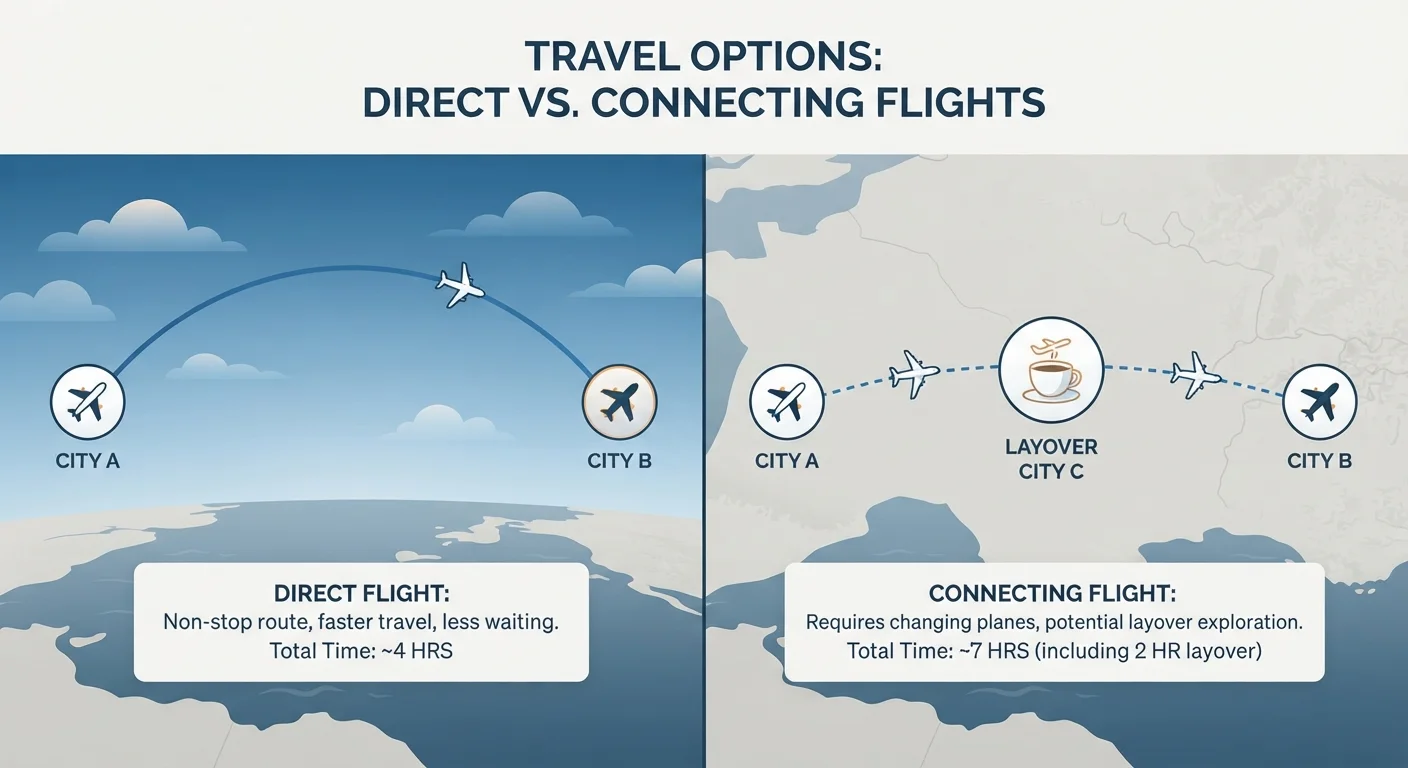
A nonstop flight goes from origin to destination without stopping. A direct flight technically may include one or more stops where passengers stay on board or re-board, but the flight number remains the same. In practice, airlines and booking engines often use the terms interchangeably, so always check whether a "direct" fare involves any intermediate stops.
A connecting flight (or itinerary) involves at least one plane change at an intermediate airport. You disembark, wait, and board a separate flight - sometimes on a different aircraft or even a different airline. This distinction matters enormously for what happens when something goes wrong. See how connecting flights work and what your rights are when a connection is missed.
The Real Cost Comparison
Connecting flights are often priced lower because airlines use hubs strategically - routing passengers through high-traffic airports allows them to fill more seats and offer more competitive fares on thin routes. The savings are real, but they are not always as large as they first appear.
| Direct / Nonstop | Connecting Flight | |
|---|---|---|
| Typical fare | Higher on popular routes | Often lower, varies by route |
| Total travel time | Shorter, predictable | Longer, includes layover |
| Missed connection risk | None | Present, depends on layover window |
| Baggage risk | Lower - single flight | Higher - multiple transfers |
| Route availability | Limited for small markets | Broader coverage nationwide |
| Suitable for families/groups | More practical | More complex to manage |
| Passenger rights if delayed | Applies to single flight | Varies by ticket structure |
What often gets missed in a simple fare comparison: time has a dollar value. If a connecting itinerary adds five hours to your trip, that represents lost work time, an extra meal at the airport, and possibly overnight accommodation if a delay cascades. There are more costs to account for than the ticket price alone - and those hidden costs hit harder on connecting itineraries.
Baggage is another variable. If you're checking a bag, a missed connection means your luggage may arrive on a later flight - or not at the same destination at all. Multiply that risk across a family of four and the calculus shifts.
Always Verify the Connection Window
When booking a connecting itinerary, look up the specific airports involved and check terminal maps. Many hub airports require inter-terminal transit via shuttle or train - what looks like a 90-minute layover can shrink to 45 usable minutes. If the airline sells you the connection on one ticket, they are responsible for rebooking if you miss it due to their delay. If you book two separate tickets, that protection disappears entirely.
Risk Factors That Change the Decision
The core risk of connecting flights is the missed connection. Most travel disruption research points to two root causes: initial flight delays and short connection windows. A layover of 60-75 minutes at a busy hub looks feasible on paper but leaves almost no buffer for a delayed departure, a gate change, or a long terminal walk.
Key risk factors to weigh:
- Layover duration: Under 90 minutes at a major hub is high-risk. Two or more hours provides a meaningful buffer.
- Hub airport complexity: Some airports require terminal changes that add 30-45 minutes of walking and shuttling.
- Seasonal weather: Winter travel through weather-prone hubs amplifies connection risk significantly.
- Booking structure: Connecting flights on a single ticket give you airline protection if a connection is missed. Separate tickets from different airlines do not - you are responsible for rebooking the second leg yourself.
For travelers who want to understand the full picture of what happens operationally when a connection is missed, this breakdown of layover logistics and passenger rights is worth reading before booking.
When Connecting Flights Make Practical Sense
There are scenarios where connecting flights are the rational choice, not just a budget compromise:
- Route coverage: Many smaller cities have no nonstop service to distant destinations. A connection isn't a trade-off - it's the only option.
- Significant price difference: If the fare gap exceeds $150-$200 per person and you have a generous layover window, the savings may justify the added complexity.
- Flexible itinerary: If your schedule allows for a same-day delay without serious consequence, the risk profile of a connection is more manageable. How you structure your travel dates affects more than just price.
- Long-haul routes: On flights spanning 10+ hours, a layover can serve as a planned rest point, especially for travelers who find extended flights physically demanding.
What connecting flights are not suited for: tight event timelines (weddings, cruises, conferences), travel with young children or elderly passengers who find transitions taxing, or any itinerary where a one-day delay would create significant downstream costs.
Before finalizing any itinerary, it's also worth thinking through your baggage strategy - whether to carry on or check a bag has real implications when connections are involved.
A Decision Framework
Rather than defaulting to the cheaper ticket, use these questions to drive the decision:
- What is the actual fare gap? Calculate per-person, after fees.
- What is the total trip time difference? Include layover time, not just flight time.
- How long is the connection window, and at which airport? Research that specific hub's on-time performance.
- Are the connecting flights on a single ticket? If not, understand the rebooking exposure.
- What is the consequence of a one-day delay? The answer should drive how much risk you're willing to accept.
If you want a more complete picture of how flight costs fit into the total trip budget, this piece on what budget travel actually costs provides useful context.