
Choosing Your Route
The single biggest planning decision for a first cross-country drive isn't where you'll sleep - it's which corridor you'll follow. The US has three primary east-west interstate frameworks: the northern I-90 corridor, the mid-country I-70/I-40 band, and the southern I-10 route. Each has a different character in terms of terrain, services, weather risk, and scenery.
Your starting and ending cities largely dictate which corridors are realistic. From there, the key filters are seasonal weather and the density of services along the route. Mountain passes on I-70 through Colorado, for instance, can be affected by late-spring snowstorms. Desert stretches on I-10 through Arizona and New Mexico carry summer heat risks that affect both drivers and vehicles. Checking regional weather windows before committing to a corridor is a practical first step, not an optional one.
If your route passes near national parks, build those as deliberate stops rather than rushed detours. See how to factor national parks into your itinerary without blowing your schedule.
Drive corridor
A primary east-west or north-south highway route connecting regions of the US, typically built around interstate highways and the services (gas, food, lodging) clustered along them.
Contingency budget
A reserved portion of your travel budget - typically 10-15% of your total estimate - set aside for unexpected costs like repairs, detours, or weather delays.
Gateway town
A small town located near a national park or major natural attraction that serves as a lodging and supply hub for visitors. These towns often have limited rooms and book up quickly.
Driver fatigue
Physical and mental tiredness caused by extended time behind the wheel. It reduces reaction time and judgment, and it builds up faster than most drivers expect on long trips.
Highway MPG
Miles per gallon a vehicle achieves at highway speeds, which is typically higher than city driving. Used to estimate fuel costs for long-distance road trips.
Budgeting for the Drive
First-time road trippers consistently underestimate total costs by focusing on fuel and ignoring everything else. A realistic budget has five line items: fuel, lodging, meals, tolls/fees, and a contingency buffer.
- Fuel: Divide total miles by your vehicle's highway MPG, then multiply by a reasonable per-gallon estimate. Prices shift constantly, so build in a margin.
- Lodging: Budget motels along interstates can run $70-$120/night; campgrounds are cheaper but require gear and time. Multiply by your number of nights on the road.
- Meals: Even cooking some of your own food, plan $30-$60/day per person for realistic road trip eating.
- Tolls and park fees: Some corridors (especially I-80 through the Midwest and I-76 in Pennsylvania) carry significant toll costs. National park entry fees apply if you're stopping inside parks.
- Contingency: Set aside 10-15% of your total estimate for unexpected repairs, weather delays, or unplanned stops.
For broader trip cost strategy, the travel budgeting hub covers how to plan without overspending or surprises.
Use a Spreadsheet Before You Book Anything
Before committing to dates or reservations, build a simple row-per-day spreadsheet with estimated miles, drive time, overnight city, and nightly accommodation cost. Seeing the full trip laid out in numbers - not just a map - often reveals schedule problems or budget gaps early, when they're easy to fix.
Vehicle Readiness and Safety Checks
Your car's condition matters far more on a 3,000-mile trip than on daily commutes. Small issues that seem ignorable at home can become costly breakdowns in rural Nevada or western Kansas - places where service options are sparse and towing fees are steep.
At a minimum, check or have a mechanic check: tire tread depth and pressure (including the spare), engine oil and coolant levels, brake pad condition, windshield wiper blades, battery health, and all exterior lights. If your vehicle is approaching a scheduled service interval, complete it before departure.
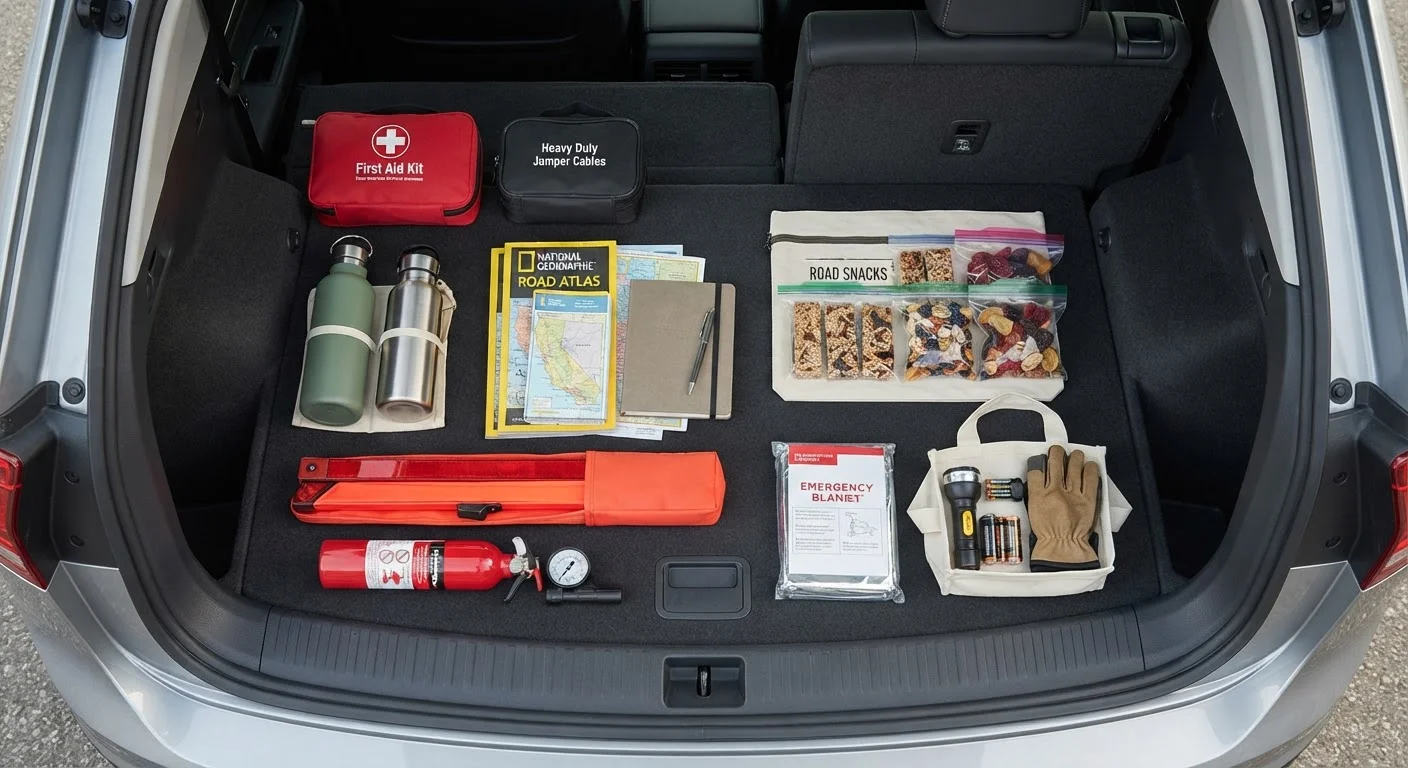
Beyond mechanical prep, put together a basic roadside kit: jumper cables or a jump starter, a flashlight, a reflective triangle or flares, a first-aid kit, and a phone charger. For a more detailed breakdown of what experienced drivers actually carry, see road trip packing essentials.
Also familiarize yourself with what fuel and cell service availability actually looks like in remote stretches - rural coverage gaps catch many drivers off guard.
Managing Daily Drive Times
One of the most common mistakes first-timers make is treating a cross-country drive like a race. Mapping software will tell you a drive is theoretically possible in two days - but that's not the same as it being safe or enjoyable to do so.
A practical guideline: cap yourself at 300-400 miles or 6-8 hours of driving per day, whichever comes first. Beyond that threshold, driver fatigue increases significantly. Fatigue catches road trippers off guard more often than almost any other hazard - it's worth understanding why before you go.
Build in a 15-minute break roughly every two hours, and don't push through late-night driving to make time. If you're traveling with others who can share driving duties, rotate every 2-3 hours. If you're going solo, structure your days so you're stopping before dark.
Booking Accommodations Along the Way
How far in advance you need to book depends heavily on where you're stopping and when. Popular gateway towns near national parks - places like Moab, Utah or Flagstaff, Arizona - fill up weeks or months out during peak season. Rural interstate towns often have availability day-of, but you can't count on it.
A workable approach: book the first and last nights firmly, then book middle nights 3-5 days ahead as your pace clarifies. This gives you flexibility without gambling on availability in tight markets.
Campsite reservations, especially at federal campgrounds, often require booking months in advance during summer. If camping is part of your plan, that reservation timeline is separate from and earlier than your motel bookings.
For a broader look at trip logistics - from travel documents to accommodation strategy - the trip logistics hub is a useful reference. And if you're questioning whether a cross-country drive is even the right move for your situation, common road trip myths addresses many of the assumptions that hold people back unnecessarily.
Don't Rely Solely on Navigation Apps for Remote Stretches
Navigation apps can route you onto poorly maintained back roads or through areas with no cell service, especially in the rural West and Southwest. Download offline maps for your corridor before departure, and cross-check any unfamiliar routes against a physical road atlas or state DOT resources. Cell coverage can disappear entirely for hours in parts of Nevada, Wyoming, and Montana.