
The Core Financial Distinction
When you pay cash for a vehicle, you transfer ownership of that capital outright. When you finance, you're borrowing against future income to acquire an asset today. Both approaches accomplish the same goal - you drive away in the car - but their financial implications diverge substantially from that point forward.
Cash buyers pay exactly the negotiated purchase price (plus taxes and fees) and nothing more. Finance buyers pay the purchase price plus interest, which accumulates over the loan term. On a $35,000 vehicle financed at 7% APR over 60 months, total interest paid would exceed $6,500. That's a real cost worth weighing against what else that money could do.
At the same time, the cash sitting in your account isn't idle - it has an opportunity cost. If those funds could reasonably generate returns in savings instruments or investments, deploying them entirely toward a depreciating asset deserves careful thought. See our overview of saving and investing fundamentals for context on how cash compares to other asset classes.
| Cash Purchase | Auto Loan Financing | |
|---|---|---|
| Total cost paid | Purchase price only | Purchase price plus interest |
| Liquidity impact | Significant capital outflow | Capital preserved; monthly payments required |
| Credit score effect | No impact on credit history | Can build credit with on-time payments |
| Dealership negotiation | May reduce dealer incentive to negotiate | Pre-approval adds leverage; complexity varies |
| Opportunity cost | Foregone returns on deployed capital | Capital remains available for other uses |
| Risk if emergency arises | Higher if reserves are depleted | Lower; liquidity maintained |
| Transaction simplicity | Straightforward; no lender involved | Requires application, approval, and documentation |
Liquidity, Risk, and the Emergency Fund Question
One of the most overlooked risks of paying cash is liquidity erosion. Depleting savings to eliminate an auto loan can leave a household dangerously thin on reserves. Financial planners generally recommend maintaining three to six months of living expenses in accessible accounts - a threshold that a large cash vehicle purchase can breach.
If paying cash for a car would leave you without an adequate emergency fund, financing may be the more prudent short-term path, even if it costs more over time. The interest paid on a modest auto loan can be a reasonable price for financial stability and flexibility.
Preserve Your Emergency Buffer First
Before committing to a cash purchase, calculate what you'd have left in accessible savings afterward. If the answer falls below three months of living expenses, consider financing part or all of the vehicle even if you technically have the funds. The cost of a modest auto loan can be far lower than the cost of taking on high-interest debt during an unexpected crisis.
Financing also preserves optionality. Keeping capital liquid means you can respond to medical expenses, job disruption, or home repairs without taking on high-interest debt elsewhere. The trade-offs of holding too much cash on the sidelines are real, but so are the risks of holding too little.
Credit, Negotiation, and the Dealer Relationship
Cash purchases do not automatically guarantee the best price at a dealership. Dealers earn revenue through financing arrangements, so a cash buyer may actually face less willingness to negotiate on the sale price. Disclosing your payment method early can sometimes work against you.
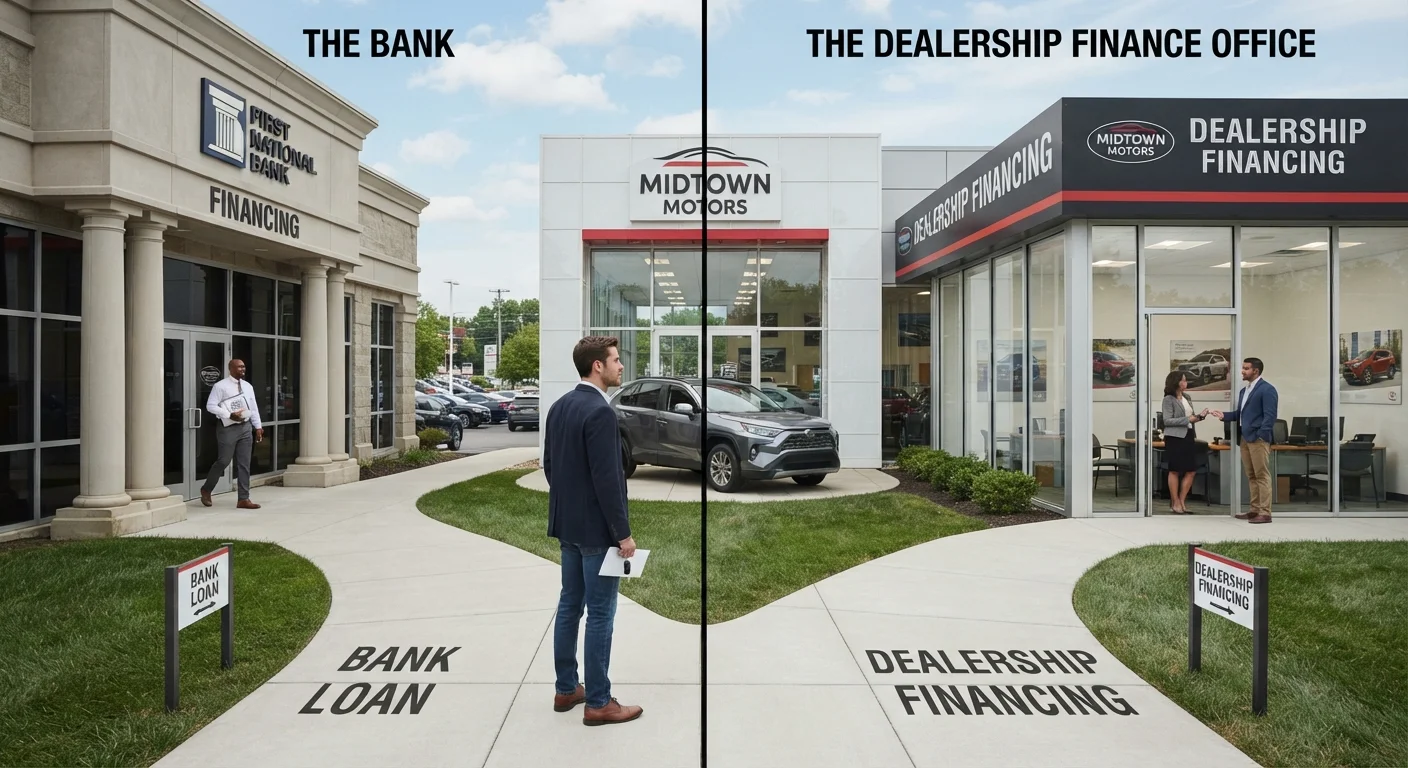
Financing, by contrast, can create additional negotiating dynamics - though complexity cuts both ways. Understanding the difference between dealer financing and direct bank or credit union loans matters here. Pre-approved financing from an outside lender gives you a rate benchmark and negotiating leverage without ceding control to the dealership's finance office.
Responsible auto loan management can also strengthen your credit profile over time, provided payments are made consistently. For buyers building or rebuilding credit history, a well-structured auto loan serves a dual purpose.
Loan term length compounds these dynamics significantly. A longer term lowers monthly payments but substantially increases total interest paid. Our comparison of short vs. long loan terms breaks down the real cost differences with concrete numbers.
Making the Decision for Your Situation
No formula produces the universally correct answer here. The financially sound choice requires an honest inventory of your current liquidity, credit standing, interest rate environment, and what your capital could realistically earn if not used for the purchase.
A useful framework: if the auto loan interest rate is materially higher than what your savings can conservatively generate, paying cash (while maintaining your emergency fund) reduces net cost. If the loan rate is low and your capital has productive uses - including simply preserving financial stability - financing may be rational even for buyers who could technically afford cash.
If you're also weighing whether to own outright versus keeping monthly obligations lower, the leasing vs. buying comparison adds another dimension to that decision. Whatever path you choose, entering the process informed about its real costs and trade-offs is what separates a sound purchase from a reactive one.
This article is for general informational and educational purposes only and does not constitute personal financial or investment advice. Consult a qualified financial professional regarding decisions specific to your circumstances.