Why Credit Myths Spread - and Why They Matter
Credit scoring is largely invisible. Most Americans never read the technical documentation behind FICO or VantageScore models, so they rely on secondhand advice - from family members, coworkers, or online forums - that can be outdated, oversimplified, or flat-out wrong. The problem is not just academic. Acting on a credit myth can mean paying unnecessary interest, watching your score drop at the worst possible moment, or missing out on a competitive loan rate.
This article works through five of the most common misconceptions, explains what is actually true, and connects the dots to how scoring models really function. For a broader foundation, our end-to-end guide to credit and debt covers the full landscape in plain terms.
This article is for general informational purposes only and does not constitute personalized financial or legal advice. Consult a qualified financial professional for guidance specific to your situation.
Myth
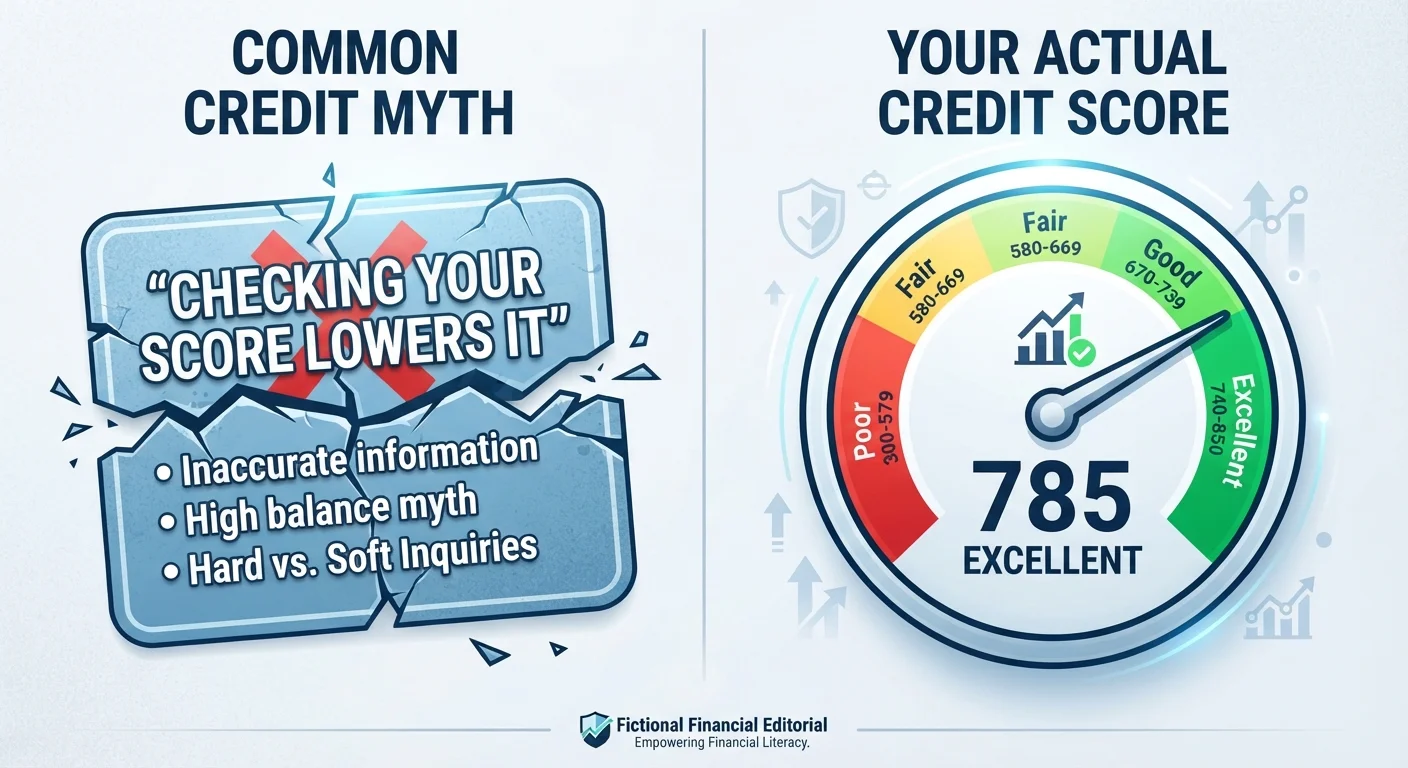
Checking your own credit score will hurt it.
Fact
Checking your own score triggers a soft inquiry, which has zero effect on your credit score.
This myth keeps many people from monitoring their own credit - which is counterproductive. Credit inquiries fall into two categories: soft and hard. When you check your own score through a credit bureau, a monitoring service, or your bank's free tool, that is a soft inquiry. Soft inquiries are visible only to you and do not factor into any scoring model. Hard inquiries - the kind generated when a lender reviews your file after you apply for credit - can trim a few points temporarily. Staying informed about your own score is always a smart habit, not a risk.
Myth
Carrying a small balance each month builds credit better than paying in full.
Fact
Paying your balance in full each month is better for your score and costs you nothing in interest.
This is one of the most costly myths in personal finance. No scoring model rewards cardholders for carrying a balance - what scoring models actually measure is your credit utilization ratio, meaning how much of your available revolving credit you are using at the time a balance is reported. Keeping that ratio low (generally below 30%, and ideally lower) benefits your score. Carrying a balance from month to month simply means paying interest, which adds up quickly. See how carrying a balance compounds over time for a clearer picture of what that interest actually costs.
Myth
Closing old or unused credit cards is good financial hygiene.
Fact
Closing accounts can raise your utilization ratio and reduce your average account age - both of which may lower your score.
Intuition says fewer open accounts means a tidier financial life. Scoring math says otherwise. When you close a card, you eliminate that card's credit limit from your total available credit, which can push your utilization ratio higher overnight. Closing an older account can also shorten the average age of your accounts, another factor that scoring models weigh. Account age and utilization together make up a significant share of your score. If a card carries an annual fee you no longer find worthwhile, contact the issuer about a product change to a no-fee card instead of closing the account outright.
Myth
Applying for multiple loans tanks your score permanently.
Fact
Rate-shopping inquiries for mortgages, auto loans, and student loans within a defined window are typically treated as a single inquiry.
Hard inquiries do cause a small, temporary score dip - but the credit bureaus built in a practical exception for rate shopping. When you apply with several lenders for the same type of installment loan within a short period (commonly 14 to 45 days depending on the scoring model), those inquiries are deduplicated and counted as one. This allows borrowers to compare offers without compounding the credit impact. How the rate-shopping window works for auto loans explains the mechanics in detail. The key is to concentrate your applications rather than spreading them out over months.
Myth
Having no debt means you have excellent credit.
Fact
No credit history produces a thin or nonexistent file, which many lenders treat similarly to poor credit.
Debt-free living is a reasonable financial goal, but lenders use credit history as evidence of how you manage obligations over time. Without any borrowing history, scoring models have little data to work with. A person with no accounts on file may receive no score at all, or a very low one by default - not because they have done anything wrong, but because the system lacks information. Building a modest credit footprint through responsible use of a single credit card or a credit-builder loan gives scoring models enough data to generate a meaningful score, which can ultimately open doors to better loan terms when you need them.
Putting Accurate Credit Knowledge to Work
Understanding what scoring models actually measure changes how you interact with credit day to day. The utilization ratio and payment history together drive the majority of your score - so paying on time and keeping balances low relative to your limits are the two highest-leverage habits you can build. Everything else, including account age and credit mix, matters but carries less weight.
35%
Weight of payment history in FICO scoring
According to FICO's published score factor breakdown, payment history is the single largest component of a standard FICO score.
30%
Weight of credit utilization in FICO scoring
FICO's published methodology identifies amounts owed - primarily your utilization ratio - as the second-largest scoring factor.
1 in 5
US adults with a credit report error
A study by the Federal Trade Commission found that approximately one in five consumers had an error on at least one of their credit reports.
If your score drops unexpectedly, resist the urge to guess. Common triggers for score dips - from a newly reported late payment to a spike in utilization - each have distinct causes and different timelines for recovery. Knowing which factor moved can help you respond effectively rather than reactively. And when you're ready to use your credit for a major purchase, understanding how your score shapes the loan terms you're offered gives you a realistic picture of what to expect before you apply.