Front-Wheel Drive: The Everyday Standard
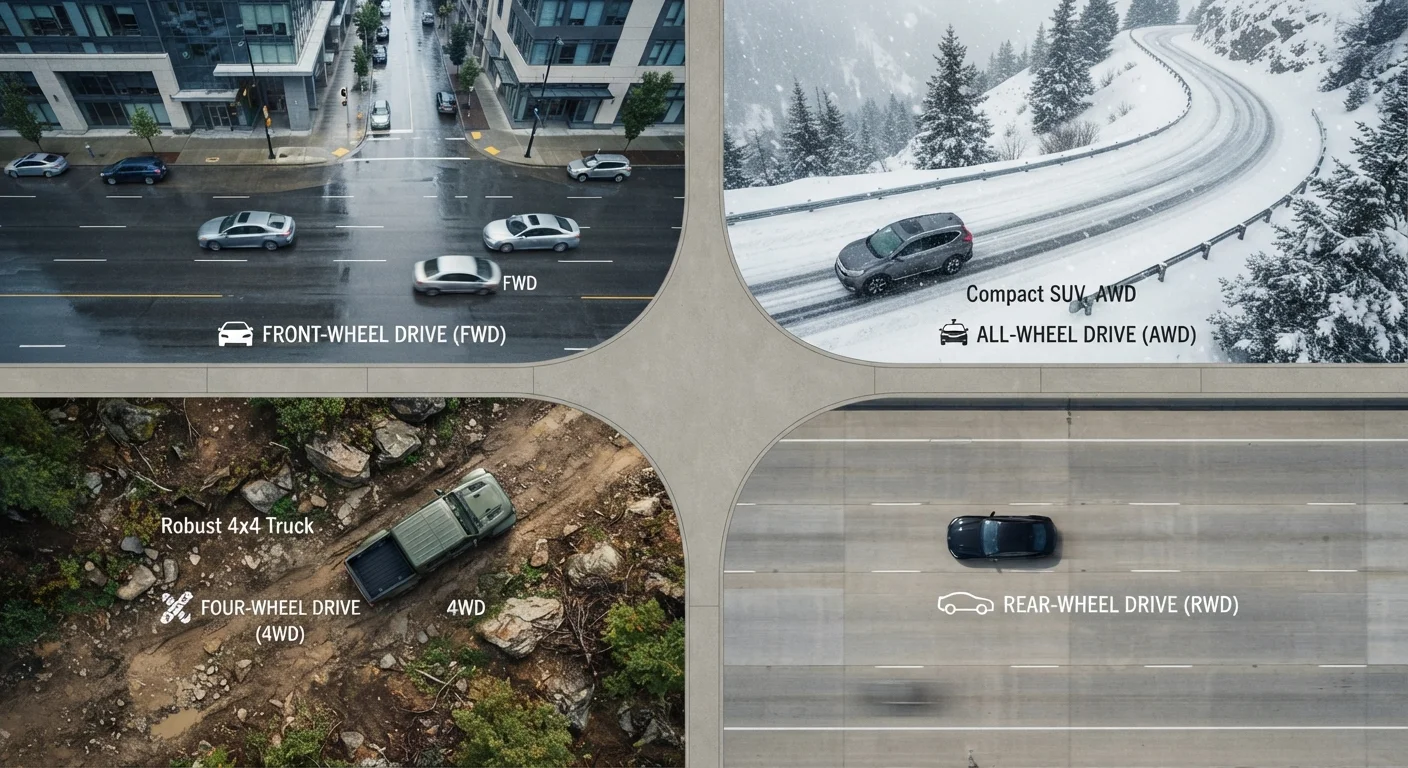
Front-wheel drive sends engine power exclusively to the front axle, which also handles steering. Because the engine, transmission, and driven wheels are clustered at one end of the vehicle, FWD packaging is compact and cost-efficient - a key reason most sedans, crossovers, and minivans use it.
FWD delivers adequate traction on wet pavement and light snow, and the weight of the drivetrain over the front wheels aids grip during acceleration. On the downside, FWD vehicles can exhibit torque steer - a pulling sensation during hard acceleration - and they tend toward understeer (pushing wide) in corners when pushed to the limit. For most commuters in mild-to-moderate climates, these trade-offs rarely matter in daily driving.
Calculate the True Cost of AWD Before Upgrading
The AWD premium on a vehicle's sticker price is only the starting point. Factor in slightly lower fuel economy over the ownership period and potentially higher maintenance costs for additional drivetrain components. For many buyers in mild climates, quality all-season or winter tires on a FWD vehicle deliver better real-world value.
Fuel economy is FWD's most tangible everyday advantage. Choosing FWD over AWD on the same model can meaningfully reduce both the sticker price and long-term fuel costs - worth quantifying before upgrading.
Rear-Wheel Drive: Balance and Towing Strength
Rear-wheel drive routes power to the back axle, leaving the front wheels free to steer. This separation creates a more neutral weight distribution and responsive handling - qualities valued in performance cars and full-size trucks alike.
RWD vehicles tend to handle towing loads more stably because the driven rear wheels push rather than pull the weight. Full-size pickup trucks and body-on-frame SUVs designed for heavy towing almost universally use RWD as the base configuration.
The liability of RWD is clear in winter: the rear can step out under acceleration on slick surfaces, making the vehicle harder to control for inexperienced drivers. In Sun Belt states where snow is rare, this limitation is largely academic. In snow-belt regions, RWD vehicles genuinely benefit from winter tires and careful throttle management.
Winter Tires Matter More Than Drivetrain
Regardless of whether a vehicle is FWD, RWD, AWD, or 4WD, braking distance on ice is primarily determined by tire compound and tread design - not which wheels are driven. A RWD vehicle on winter tires will stop shorter on ice than an AWD vehicle on all-season tires. Drivetrain choice and tire choice are separate, equally important decisions.
All-Wheel Drive: Automatic Traction for Mixed Conditions
AWD systems continuously monitor wheel slip and redistribute torque between axles - and sometimes between individual wheels - without any driver action. This makes AWD the drivetrain of choice for commuters who encounter variable weather but don't need off-road capability.
Modern AWD architectures vary considerably. Some vehicles run in FWD mode most of the time and only engage the rear axle when slip is detected (on-demand AWD). Others distribute torque constantly across all four wheels (full-time AWD). Handling and efficiency implications differ between systems, so checking a vehicle's specific AWD setup - not just its label - is worthwhile.
AWD adds cost, weight, and mechanical complexity. It also has no low-range gear ratio, making it unsuitable for serious rock crawling or deep mud. For buyers weighing the upgrade, pairing AWD with quality all-season or winter tires will do more for safety on icy roads than AWD alone. See how drivetrain interacts with body style in our guide on matching vehicle type to your daily life.
~47%
New US vehicles sold with AWD or 4WD
Industry analysts have tracked AWD/4WD's share of new vehicle sales rising steadily through the early 2020s, reflecting crossover and SUV market growth.
1-3 MPG
Typical fuel economy reduction with AWD
EPA fuel economy data consistently shows AWD variants of the same model returning fewer miles per gallon than their FWD counterparts due to added weight and mechanical drag.
$1,500-$3,000+
Typical AWD or 4WD option cost premium
Manufacturer pricing across mainstream vehicle segments shows AWD/4WD hardware adding this range to a vehicle's purchase price before incentives or negotiations.
Four-Wheel Drive: Serious Off-Road Capability
Traditional 4WD - common on trucks, body-on-frame SUVs, and dedicated off-road vehicles - uses a transfer case to lock the front and rear axles together, forcing them to rotate at the same speed. A low-range setting multiplies torque for extreme terrain: steep grades, deep mud, sand, or rock.
This rigid coupling is what makes 4WD so capable off-road and so problematic on dry pavement. Driving in 4H or 4L on a dry, high-traction surface causes drivetrain bind - stress that can damage axles, differentials, and the transfer case. Most manufacturers explicitly warn against it in their owner's manuals.
For buyers who genuinely venture off-road or live on unmaintained rural roads, 4WD's low-range capability is irreplaceable. For buyers who simply want winter confidence on cleared roads, AWD is a simpler and often more capable daily solution. Consider how your off-road or towing needs connect to overall vehicle choice by reviewing key questions to ask before settling on a vehicle class.
Matching Drivetrain to Your Situation
Drivetrain is only one dimension of the vehicle decision. Powertrain type, body style, and financing all interact - the powertrain spectrum guide is a useful companion read before finalizing any configuration.
- Flat or mild-winter climates, budget-conscious: FWD covers most needs well.
- Performance driving or heavy towing in moderate climates: RWD on an appropriate platform is the cleaner engineering choice.
- Year-round mixed weather, no off-road use: AWD, paired with good tires, offers reliable confidence with minimal driver effort.
- Genuine off-road use, remote unpaved roads, deep snow: 4WD with low-range capability is the appropriate tool.
Budget realism matters here. AWD and 4WD systems typically add $1,500 to $3,000 or more at purchase and carry ongoing fuel and maintenance costs. If you're financing the vehicle, those costs compound - the auto financing basics guide explains how to factor equipment costs into your total loan picture.
This article is for general informational purposes only and does not constitute financial or mechanical advice. Consult a licensed mechanic or financial professional for decisions specific to your situation.