
Why Motivation Isn't Enough
Most people who start a budget do so with genuine enthusiasm. They track every dollar for a week or two, then gradually abandon the habit when life gets busy or an unexpected expense throws the plan off. The problem usually isn't willpower - it's the absence of a reliable system.
Behavioral research consistently shows that habits are sustained by environment and routine, not by repeated bursts of motivation. This is as true for money management as it is for exercise or nutrition. If you'd like to explore what the science says about habit formation across domains, see what behavioral science reveals about sticking with habits.
The habits below are drawn from that research and from widely recognized personal finance principles. They don't require extraordinary self-control - they require setup.
The Role of Automation and Simplicity
One reason budgets collapse is decision fatigue. Every time you manually decide whether to transfer money to savings or pay a bill, you create an opportunity to procrastinate or rationalize. People who sustain budgets over years tend to remove those decision points by automating them.
Automation also reinforces the savings-first principle - the practice of directing money toward goals before it enters your spending account. If you're building this habit from scratch, this guide to building a savings habit walks through practical approaches for getting started.
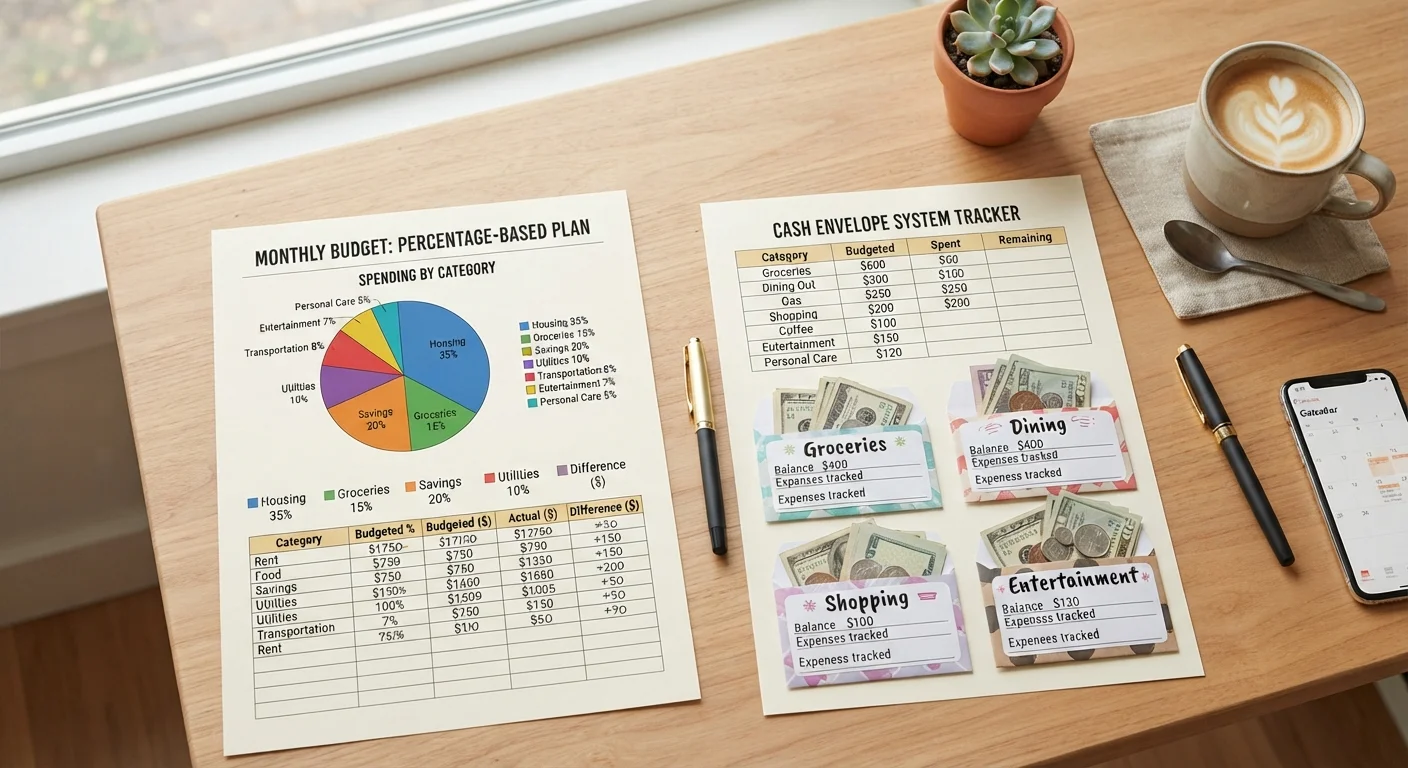
Simplicity matters equally. Overly detailed budgets with twenty categories are harder to maintain than ones with five or six meaningful buckets. If you're unsure which structure fits your life, this comparison of popular budgeting frameworks may help you choose.
Regular Reviews Keep Plans Realistic
Budgets that never get revisited quickly become irrelevant. Income changes, recurring costs shift, and irregular expenses - car repairs, medical bills, annual subscriptions - arrive without warning. People who stick to their budgets treat the monthly or weekly review not as a chore but as a brief calibration.
68%
Americans without a detailed monthly budget
According to a Gallup survey, roughly two-thirds of U.S. households do not maintain a detailed household budget, underscoring how common the gap between intention and follow-through is.
3x
Likelihood of reaching savings goals with automation
Research from behavioral economics literature consistently finds that people who automate savings contributions are significantly more likely to meet their targets than those who rely on manual transfers.
A review doesn't need to take long. Even ten to fifteen minutes spent comparing actual spending against the plan can reveal patterns - categories that are consistently over or under - that allow you to adjust before the gap grows. Missing this step is one of the subtle patterns that quietly undermine long-term savings goals.
If a category is repeatedly blown, that's information: either the budget is unrealistic for that area, or a behavioral trigger needs addressing. Both are solvable with adjustment rather than abandonment.
Consistent budgeting also supports broader financial health. The same discipline that prevents overspending supports responsible borrowing habits and keeps debt manageable over time.
This article is for general informational and educational purposes only. It does not constitute personalized financial, tax, or legal advice. Consult a qualified financial professional for guidance specific to your situation.