Why the Nutrition Facts Label Exists - and What It Can and Can't Do
The Nutrition Facts panel is a federally standardized tool regulated by the US Food and Drug Administration (FDA). It's required on most packaged foods sold in the United States and was last significantly updated in 2020 to better reflect current eating patterns and nutritional science. Its purpose is to give consumers consistent, comparable information - not to dictate what anyone should eat.
Reading the label well means understanding its structure and limitations. It tells you what's in a food per serving; it doesn't tell you whether that food fits your individual health goals, medical needs, or lifestyle. No label can substitute for guidance from a registered dietitian or physician when those questions are genuinely clinical. With that framing in place, the label becomes a genuinely useful everyday tool.
This Is General Nutrition Education
The information in this article is intended for general educational purposes and does not constitute medical or dietary advice. Individual nutritional needs vary significantly based on age, health status, medications, and other factors. If you have specific health concerns or dietary requirements, consult a registered dietitian or qualified healthcare professional before making changes to your diet.
If you're curious how this kind of label literacy extends to other contexts - from pet food to product spec sheets - the underlying skill of reading standardized information systematically is transferable. See, for example, how pet food labels work for an interesting comparison.
How to Read Each Section: A Step-by-Step Walkthrough
The Nutrition Facts panel follows a consistent top-to-bottom structure. Reading it in order - rather than jumping to the number that catches your eye - gives you the most accurate understanding of what the data actually means.
What you will need
The Nutrition Facts Panel
The standardized FDA-regulated label printed on most packaged foods - your primary reference for all nutrient data.
Ingredient List
Located below or near the Nutrition Facts panel; reveals what the product is actually made of and in what relative proportion.
Smartphone calculator or notes app
Useful for quickly multiplying nutrient values when you're eating more or less than the listed serving size.
Start With Serving Size and Servings Per Container
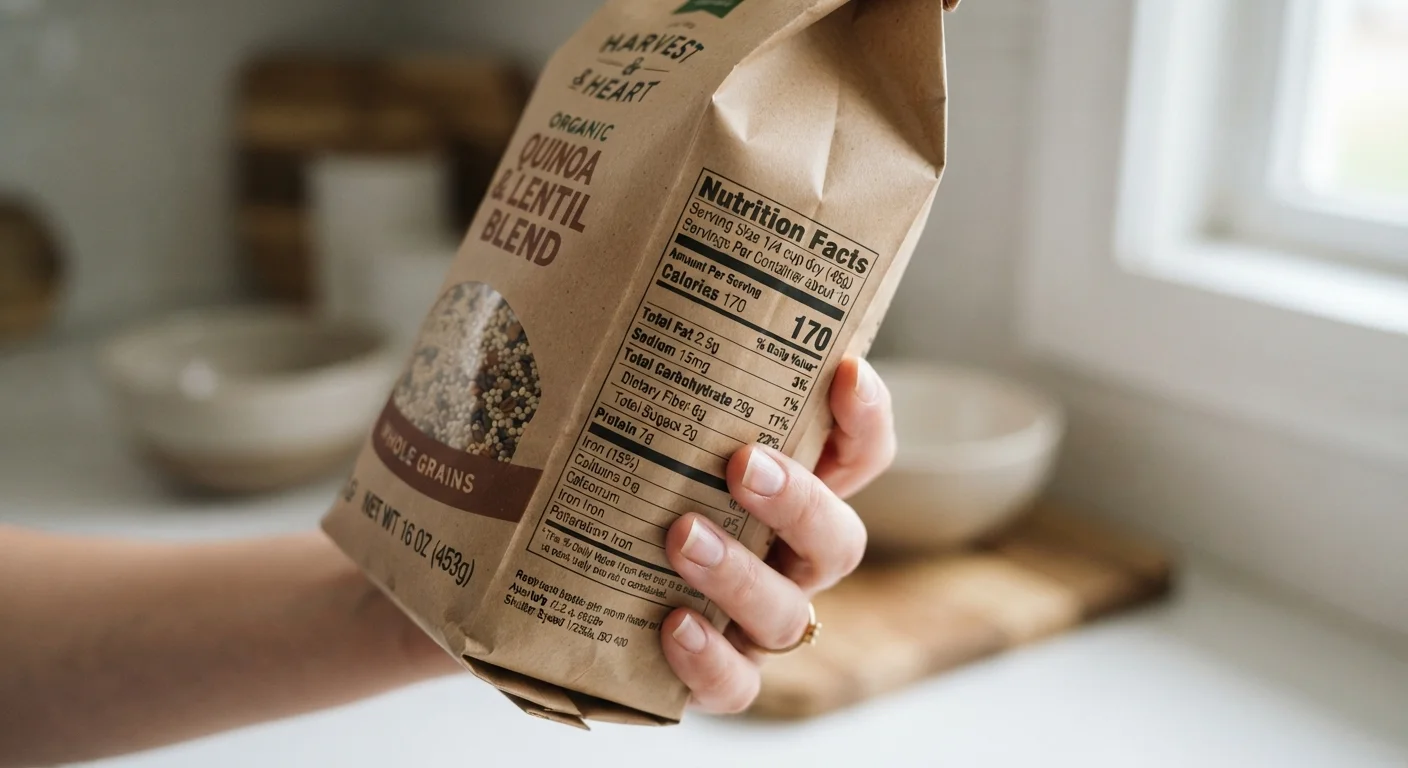
Before any other number on the label means anything, you need to know what quantity it refers to. The serving size appears at the very top of the panel in both a household measure (e.g., "1 cup") and a gram weight. Directly below it, servings per container tells you how many of those portions are in the whole package.
Every calorie count and nutrient figure listed on the label applies to one serving, not the full package. If you eat two servings, you double every number. This single step resolves the most common source of label confusion.
Check the Calorie Count in Context
Calories are displayed in large, bold type directly below the serving size information. This figure represents the total energy provided by one serving, combining calories from carbohydrates, proteins, and fats.
Calories are one data point, not the whole story. A food can be calorie-dense and nutrient-rich (like nuts) or calorie-moderate but nutrient-poor. For a fuller picture of how calorie data fits into a broader diet, see our exploration of calorie tracking.
Read the Macronutrient Section
Below calories, the label lists the three macronutrients - Total Fat, Total Carbohydrate, and Protein - along with their key sub-components:
- Total Fat breaks down into saturated fat and trans fat. Saturated fat has a %DV; artificial trans fat is listed but ideally should be 0g.
- Total Carbohydrate includes dietary fiber and total sugars. Added sugars are broken out separately - these are sugars introduced during processing, distinct from naturally occurring sugars in fruit or dairy.
- Protein does not carry a required %DV on most labels for adults, but the gram count is still useful for comparison.
For a deeper look at why fiber deserves particular attention, see our article on dietary fiber and why it's underestimated.
Interpret Percent Daily Value (%DV)
The right-hand column of the Nutrition Facts panel shows %DV for most listed nutrients. This figure represents the percentage of a recommended daily intake that one serving provides, based on a 2,000-calorie reference diet established by the FDA.
%DV is a comparison tool, not a prescription. Your personal calorie and nutrient needs may be higher or lower depending on your age, sex, activity level, and health status. Use %DV to quickly gauge whether a food is relatively high or low in a particular nutrient.
[tip_callout]Review Vitamins, Minerals, and Sodium
The lower section of the panel lists micronutrients - currently required to include Vitamin D, Calcium, Iron, and Potassium with their %DV. These were prioritized by the FDA based on public health data showing common insufficiencies in the US population.
Sodium appears in the upper nutrient section and has its own %DV. Sodium intake is a widely discussed factor in cardiovascular health discussions, though how much matters for any individual depends on their personal health context. For broader context on vitamins and minerals, our micronutrient reference guide covers each one in plain language.
Scan the Ingredient List
The ingredient list isn't part of the Nutrition Facts panel itself, but it's on the same label and completes the picture. Ingredients are listed in descending order by weight - whatever appears first makes up the largest proportion of the product.
A long list isn't automatically problematic, and a short one isn't automatically wholesome. Look at what the first three to five ingredients are, whether whole foods or recognizable components appear near the top, and whether any ingredients you want to minimize (such as partially hydrogenated oils or high-fructose corn syrup) appear.
To build on this skill at the store, see our Grocery Store Nutrition Audit guide, which walks through a broader set of label evaluation questions.
Hydration also plays a role in how your body processes nutrients - a dimension the label doesn't capture. Our article on hydration and nutrition covers why water intake matters alongside what you eat.
This article is for general informational and educational purposes only and is not a substitute for professional medical or dietary advice. Consult a qualified healthcare provider or registered dietitian for guidance tailored to your individual health needs.