
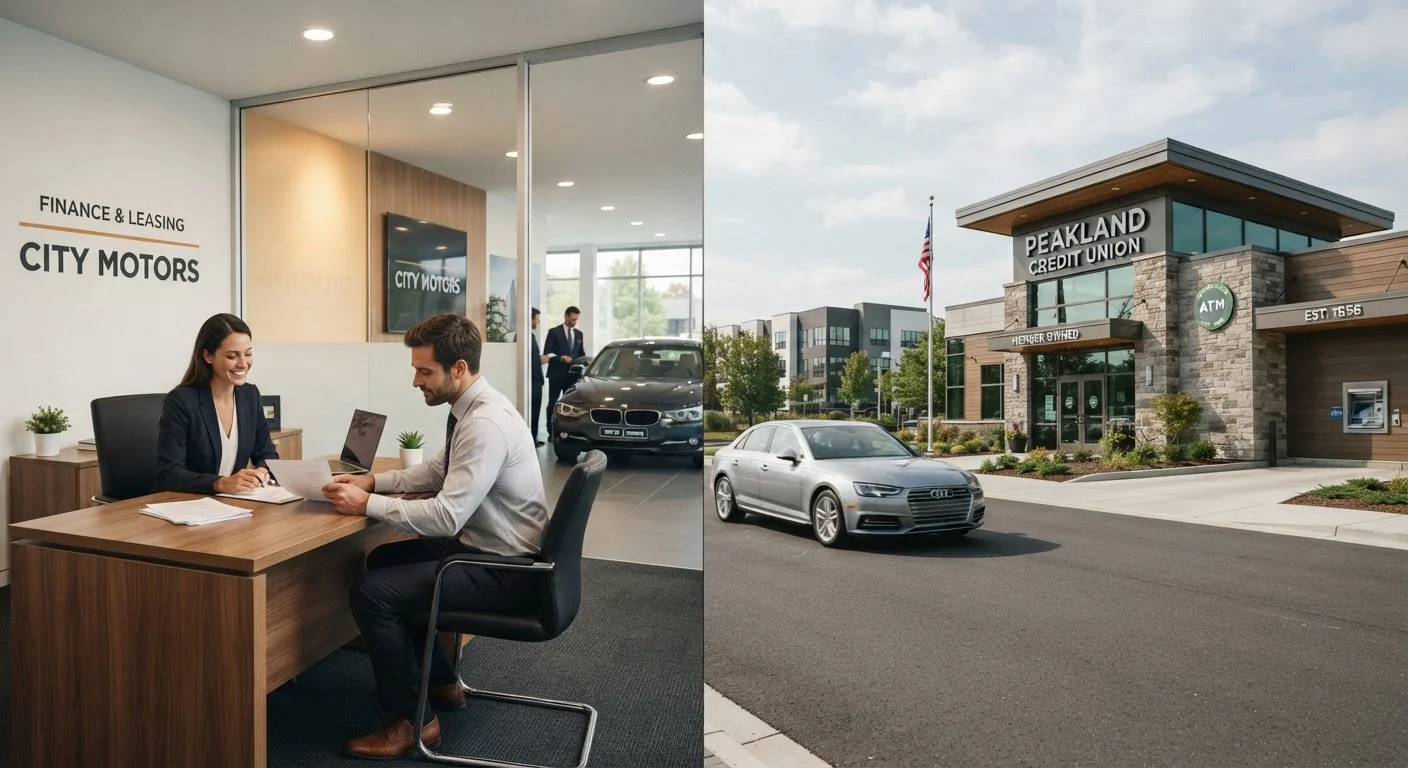
How Each Financing Path Actually Works
When you finance a vehicle through a dealership, the dealer typically submits your application to one or more lenders - often a captive finance arm tied to the manufacturer - and then presents you with an offer. The dealer may mark up the interest rate above what the lender actually approved, pocketing the difference as dealer reserve. This practice is legal and common, but not always disclosed upfront.
Outside financing, by contrast, means securing a loan directly from a bank, credit union, or online lender before visiting the dealership. You receive a pre-approval letter specifying the loan amount, term, and APR (annual percentage rate - the full annualized cost of borrowing). That letter functions as a baseline: if the dealer can beat it, you have a genuine decision to make. If they can't, you use your own loan.
For a foundational overview of loan mechanics and terminology, see our guide to auto financing from the ground up.
The Case for Dealer Financing
Dealer financing has a legitimate advantage in one scenario: manufacturer-subsidized promotional rates. Automakers periodically offer deeply discounted APRs - sometimes as low as 0% - through their captive lending arms to move specific models. These rates are not available through banks or credit unions and are funded directly by the manufacturer as a sales incentive.
Dealers also offer convenience. A single credit application, processed in-house, can yield multiple lender offers within a short window, and the financing is integrated with the purchase transaction. For buyers with strong credit who qualify for promotional rates, this path can be genuinely cost-effective.
Access to manufacturer-subsidized promotional APRs
Captive lenders tied to automakers occasionally offer below-market or 0% APR deals on select models that no bank or credit union can match, representing genuine savings for qualifying buyers.
Streamlined, single-location transaction
Completing financing at the dealership consolidates the purchase process, reducing the number of steps a buyer needs to take before driving away.
Multiple lender quotes from one application
Dealers often submit a single application to multiple lenders simultaneously, which can surface competitive offers without requiring the buyer to shop each institution individually.
The key limitation is transparency. Without an external benchmark, you have no immediate way to know whether the rate you're being quoted is the lender's actual approved rate or a marked-up version. This information asymmetry tends to favor the dealer.
The Case for Outside Financing
Arriving at a dealership with a pre-approved loan fundamentally changes the dynamic. You know your rate, your ceiling, and your monthly payment before any sales conversation begins. Dealers are aware that a buyer with outside financing is comparison-shopping - which creates pressure to compete on the rate rather than obscure it.
Credit unions, in particular, tend to offer competitive rates and are member-owned, meaning they have less structural incentive to maximize interest income. Banks offer similar direct-lending options, and online lenders have expanded access for buyers across a wide range of credit profiles.
Dealers may mark up the lender's approved rate
The difference between the rate a lender approves and the rate a dealer quotes you - called dealer reserve - represents additional profit for the dealership and additional cost for you that is not always disclosed.
No external benchmark without prior research
Entering a dealership without a competing offer means you cannot immediately evaluate whether the financing presented is favorable, neutral, or expensive relative to the market.
Promotional rates apply only to specific vehicles and profiles
Manufacturer incentive rates are typically restricted to certain model years, trim levels, or credit tiers, meaning many buyers will not qualify for the advertised rate.
Financing and price negotiations can become entangled
When dealers manage both the vehicle price and the financing, it becomes easier for them to adjust one variable to obscure movement in another, complicating the buyer's ability to assess the true deal.
One underappreciated benefit: separating financing from the dealership conversation also makes it easier to negotiate the vehicle price as a standalone figure, rather than letting the dealer blend price, trade-in value, and payment into a single blurry number. See our article on keeping trade-in and purchase price separate for more on that dynamic.
To understand what the pre-approval process covers - and what it doesn't commit you to - our piece on preapproval before you shop goes into specific detail.
Where Buyers Tend to Lose Ground
The finance and insurance (F&I) office is where many buyers who focused on price find that their overall deal deteriorates. Add-on products - extended warranties, GAP insurance, paint protection - are often presented alongside financing, and the monthly payment framing can make expensive additions seem marginal. Our article on what the F&I office is actually selling breaks down what's being offered and how to evaluate each item.
Rate Shopping and Your Credit Score
When you apply for auto financing from multiple lenders within a short window - typically 14 to 45 days depending on the scoring model - most credit bureaus treat those inquiries as a single event for scoring purposes. This means shopping several lenders for competing rates carries minimal credit score impact when done within that window. Checking your own credit report beforehand costs nothing and alerts you to any errors that could affect your rate.
Focusing solely on the monthly payment is another common vulnerability. A lower monthly payment can be achieved by extending the loan term, which increases total interest paid over the life of the loan. Always evaluate offers on total loan cost and APR, not payment size alone.
~80%
New car buyers who finance through dealerships
Industry estimates consistently show that a large majority of new vehicle buyers use dealer-arranged financing, making it the dominant channel by volume.
1-2%
Typical dealer interest rate markup range
Consumer finance research has documented that dealer reserve markups frequently fall in the range of one to two percentage points above the lender's approved rate, though this varies by deal.
Before signing anything, use our car financing readiness checklist to verify every term in your agreement.