
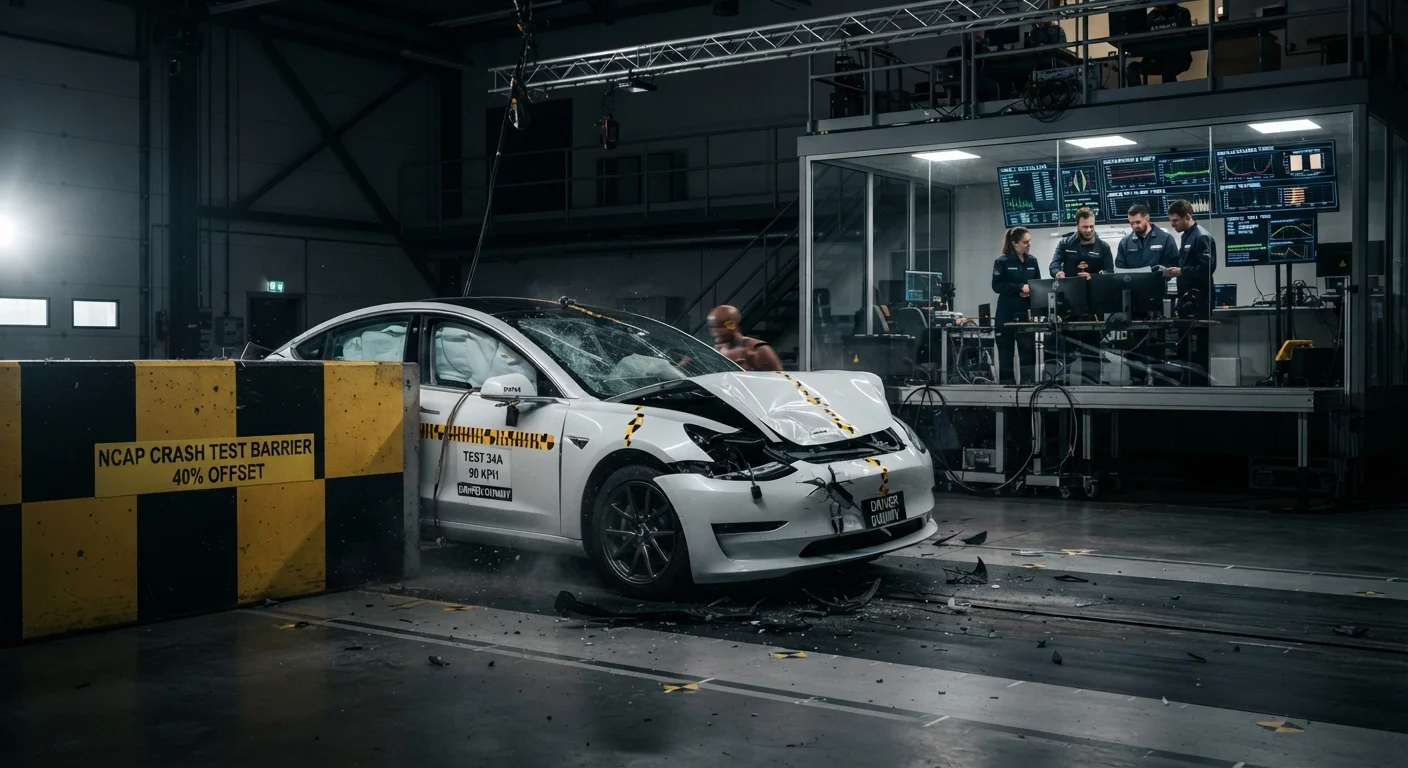
Two Independent Programs, Two Different Questions
When you see a safety rating on a vehicle window sticker or in an advertisement, it almost certainly comes from one of two organizations: the National Highway Traffic Safety Administration (NHTSA) or the Insurance Institute for Highway Safety (IIHS). Both evaluate vehicle crashworthiness, but they ask fundamentally different questions - and understanding the distinction is essential for making sense of the numbers.
| NHTSA Rating Scale | 1 to 5 stars (5 is highest) (NHTSA NCAP program) |
| IIHS Rating Scale | Good, Acceptable, Marginal, Poor (IIHS testing program) |
| NHTSA Governing Body | U.S. federal government agency |
| IIHS Funding Source | Auto insurance industry (IIHS organization overview) |
| IIHS Top Award | Top Safety Pick+ (TSP+) (IIHS TSP+ criteria) |
| Small Overlap Test Introduced | 2012 (by IIHS) (IIHS crash test history) |
NHTSA is a federal agency operating under the U.S. Department of Transportation. Its New Car Assessment Program (NCAP) assigns star ratings from 1 to 5 across three broad categories: frontal crash, side crash, and rollover. The goal is a standardized, government-run benchmark that automakers must reference when selling vehicles to consumers.
IIHS, by contrast, is a nonprofit funded by the auto insurance industry. Its interest is in reducing injury claims - which means it focuses on real-world crash patterns and pedestrian-related outcomes. Ratings come in four tiers: Good, Acceptable, Marginal, and Poor. The IIHS also issues its Top Safety Pick and Top Safety Pick+ designations, which require strong scores across multiple test categories along with acceptable headlight performance. For a broader look at how to interpret rating systems across consumer products, see how aggregate scores can mislead.
What Each Agency Actually Tests
The agencies' methodologies diverge most sharply in their crash configurations. NHTSA runs a full-width frontal barrier test at 35 mph, a moving deformable barrier side test, and a pole test for side-impact scenarios. Its rollover rating measures a vehicle's static stability factor and supplements it with a dynamic handling test.
IIHS tests a moderate overlap frontal crash (40 mph, 40% of the front end against a deformable barrier), a small overlap frontal crash (25% of the front end against a rigid barrier), side impact tests, and - added more recently - updated side tests that use a heavier barrier to simulate SUV-to-sedan collisions. IIHS also evaluates headlights, which NHTSA does not score as part of its star system.
A High Score From One Agency Doesn't Guarantee the Other
Because NHTSA and IIHS test different crash configurations, a vehicle can earn five stars from NHTSA but receive a Poor or Marginal rating from IIHS on a specific test - and vice versa. Checking both agency results before purchasing gives you a more complete picture of how a vehicle may perform in real-world collisions.
The small overlap frontal test, introduced by IIHS in 2012, exposed significant structural weaknesses in vehicles that had previously earned top NHTSA scores. That test simulates striking a tree or utility pole with the outer edge of the vehicle - a scenario the NHTSA full-width test does not replicate. This is why a vehicle can carry a 5-star NHTSA rating and still receive a Poor IIHS result: the tests simply aren't measuring identical events.
Similarly, NHTSA evaluates rollover resistance, which IIHS does not score. If rollover risk is a concern based on your driving environment or vehicle type, NHTSA's rollover rating is the primary reference point.
How to Use Both Scores Together
Neither agency's ratings are comprehensive on their own. A practical approach is to treat NHTSA and IIHS scores as complementary data sources rather than competing claims. Start by checking NHTSA's overall star rating and its sub-scores for frontal, side, and rollover performance. Then cross-reference with IIHS to see results for the small overlap test and headlight quality - two areas NHTSA doesn't cover in the same way.
25%
Front-end overlap in IIHS small overlap test
IIHS designed the small overlap test to replicate a common real-world crash scenario not captured by full-width frontal tests.
5 Stars
Highest possible NHTSA NCAP rating
NHTSA awards ratings across overall, frontal, side, and rollover categories, each scored independently.
40 mph
Speed used in IIHS moderate overlap frontal test
The IIHS moderate overlap test uses a deformable barrier at 40 mph, designed to simulate a real-world head-on collision scenario.
If a vehicle receives Good ratings from IIHS and 5 stars from NHTSA across all categories, that convergence is meaningful. Where the scores diverge, investigate why. A 4-star NHTSA score paired with a Poor IIHS small overlap result warrants a closer look at what specific structural shortcomings drove the IIHS outcome.
Safety ratings also complement - rather than replace - reliability data. A vehicle that scores well in crash tests but has a poor long-term mechanical record presents a different kind of risk. See what reliability ratings actually measure for how to factor in that dimension alongside crash performance. Just as expert testing and user reviews measure different things, NHTSA and IIHS data each capture what the other misses - and together they give you the most complete safety picture available before a purchase.