
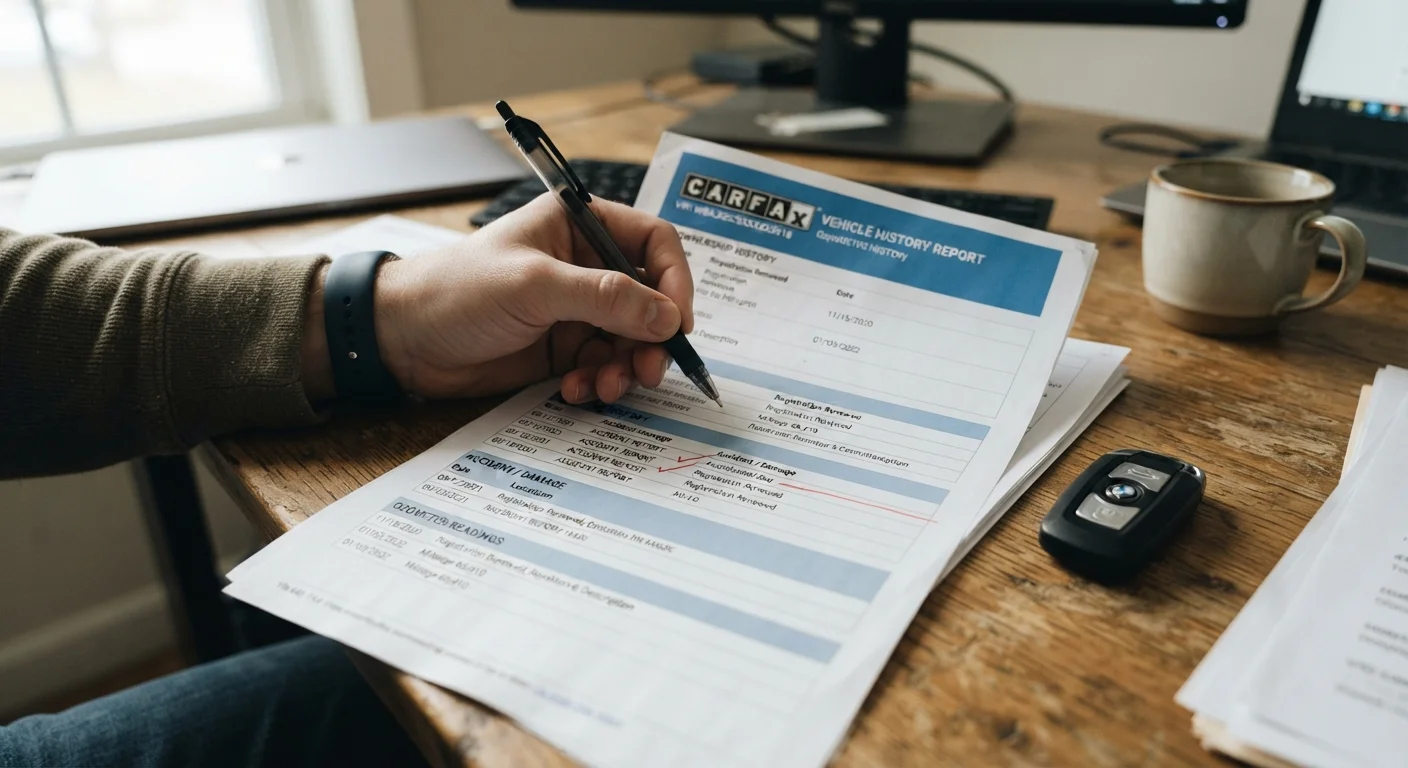
What a Vehicle History Report Actually Contains
A vehicle history report aggregates data from state motor vehicle agencies, insurance companies, auto auctions, salvage yards, and service facilities into a single timeline for a specific vehicle, identified by its VIN. The report is a compiled record - not a live inspection - and its accuracy depends entirely on whether events were reported to participating data sources.
Most reports are organized into four core areas: title and ownership history, odometer readings, accident and damage events, and service records. Understanding what each section covers - and what it cannot cover - is the foundation of reading one effectively.
What you will need
For readers navigating financing decisions alongside this process, our guide to reading an auto loan offer without missing the fine print walks through loan disclosures with the same line-by-line discipline.
Tools and Access You'll Need
Pulling and reading a report requires minimal preparation, but what you do before you read it matters as much as the reading itself.
Vehicle Identification Number (VIN)
The unique 17-character code required to pull any history report for the specific vehicle.
Vehicle history report service
Provides the compiled event history - title records, accident data, odometer readings, and ownership transfers.
State DMV title records
Used to cross-verify title branding, especially when a vehicle has crossed state lines.
Independent mechanic
Performs a pre-purchase inspection to catch mechanical or structural issues the report cannot reveal.
Cross-Check the VIN Before You Pull the Report
Locate the 17-character Vehicle Identification Number (VIN) on the driver's side dashboard and on the door jamb sticker, and confirm they match. A mismatch between those two locations is itself a red flag suggesting the vehicle may have been rebuilt from multiple vehicles or the identity altered.
How to Read the Report Step by Step
Work through the report systematically rather than scanning for highlighted warnings. Providers use different formatting, but the categories below are present in all standard reports. Follow these steps in order.
Verify the VIN and Report Match the Physical Vehicle
Before reading a single line of the report, confirm the VIN on the report matches the VIN on the car itself. Check the dashboard plate (visible through the windshield on the driver's side) and the door jamb sticker. Also compare the VIN against the title document if the seller has it available.
Read the Title History Section First
The title history is the most consequential section of any vehicle history report. Look for the following title brands and understand what each one means:
- Salvage: The vehicle was declared a total loss by an insurer, typically due to significant collision, flood, or theft damage.
- Rebuilt/Reconstructed: A previously salvaged vehicle that passed a state inspection after repairs - but structural integrity and safety systems may still be compromised.
- Flood/Water Damage: Corrosion in electrical systems and hidden mold can appear months or years after the initial event.
- Lemon Law Buyback: The manufacturer repurchased this vehicle under a state lemon law, indicating persistent defects that could not be corrected.
Any branded title should prompt serious scrutiny. A salvage or rebuilt title will also affect insurance availability and resale value.
Check Odometer Readings in Chronological Order
Vehicle history reports list odometer readings at each recorded event - service visits, inspection records, or ownership transfers. Read them in date order and look for two specific problems:
- Rollback: A later entry shows fewer miles than an earlier entry. This is a strong indicator of odometer fraud.
- Unexplained jumps: An implausibly large mileage increase between events could indicate missing records or that the vehicle was used commercially without disclosure.
Compare the final recorded mileage on the report against the current odometer reading on the car. A significant discrepancy between the two warrants an explanation from the seller.
Analyze the Accident and Damage Event History
This section lists reported collisions, insurance claims, and damage events. For each entry, note:
- The severity designation (minor, moderate, severe) and which part of the vehicle was affected
- Whether airbags deployed - airbag deployment typically indicates a significant impact
- Whether structural or frame damage is explicitly noted, as this affects safety and alignment permanently
Be aware that this section only reflects reported events. A vehicle can have sustained collision damage repaired out-of-pocket without any record appearing here.
Examine Ownership History and Registration Patterns
Review how many owners the vehicle has had and how long each owner kept it. Frequent short-term ownership - multiple owners within one or two years - can indicate recurring problems that frustrated previous buyers. Also note whether the vehicle was registered as a personal vehicle, rental fleet unit, or commercial vehicle, as fleet and rental use patterns differ significantly from private ownership in terms of wear and maintenance standards.
Assess the Service and Maintenance Record
Service records logged at participating dealerships and repair shops appear here. Look for:
- Regular oil changes and scheduled maintenance at appropriate intervals
- Documented repairs for known recalls or technical service bulletins
- Gaps in service history - especially significant gaps before a private sale listing
Thin or absent service records are not automatically disqualifying, but they shift more risk onto you as the buyer. This is one reason an independent mechanic inspection is essential regardless of what the report shows.
A Report Is Not a Guarantee
Vehicle history reports only capture events that were reported to participating agencies - insurance claims, titled transfers, and service visits logged at participating shops. Unreported accidents, cash repair jobs, and private maintenance are invisible to any report. Always pair the report with an independent pre-purchase inspection by a qualified mechanic before finalizing any deal.
Common Red Flags and What They Mean in Practice
Not every issue on a report is a deal-breaker, but certain combinations warrant serious caution:
- Salvage title + recent reconditioning records: The vehicle may have been cosmetically restored without adequate structural repair.
- Multiple states in a short timeframe + title brand discrepancy: Possible title washing - see the warning below.
- Zero service records on a high-mileage vehicle: Maintenance may have been performed but not logged, or it may have been skipped entirely.
Watch for Washed Titles Across State Lines
Some sellers move a salvage-titled vehicle through states with less stringent title branding rules in order to obtain a cleaner-looking title - a practice known as title washing. If the report shows the vehicle was registered in multiple states in a short period, research each state's title branding laws and cross-reference the event history carefully before proceeding.
Once you've reviewed the report and completed a mechanical inspection, your next steps involve evaluating the full financial picture. Our car financing readiness checklist covers what to confirm before committing. And if you want to sharpen your general eye for documentation red flags beyond vehicles, the principles in spotting red flags in product listings apply broadly to any significant purchase.
This article is for general informational and educational purposes only. It does not constitute financial, legal, or mechanical advice. Consult a qualified mechanic, licensed dealer, or financial professional regarding decisions specific to your situation.