
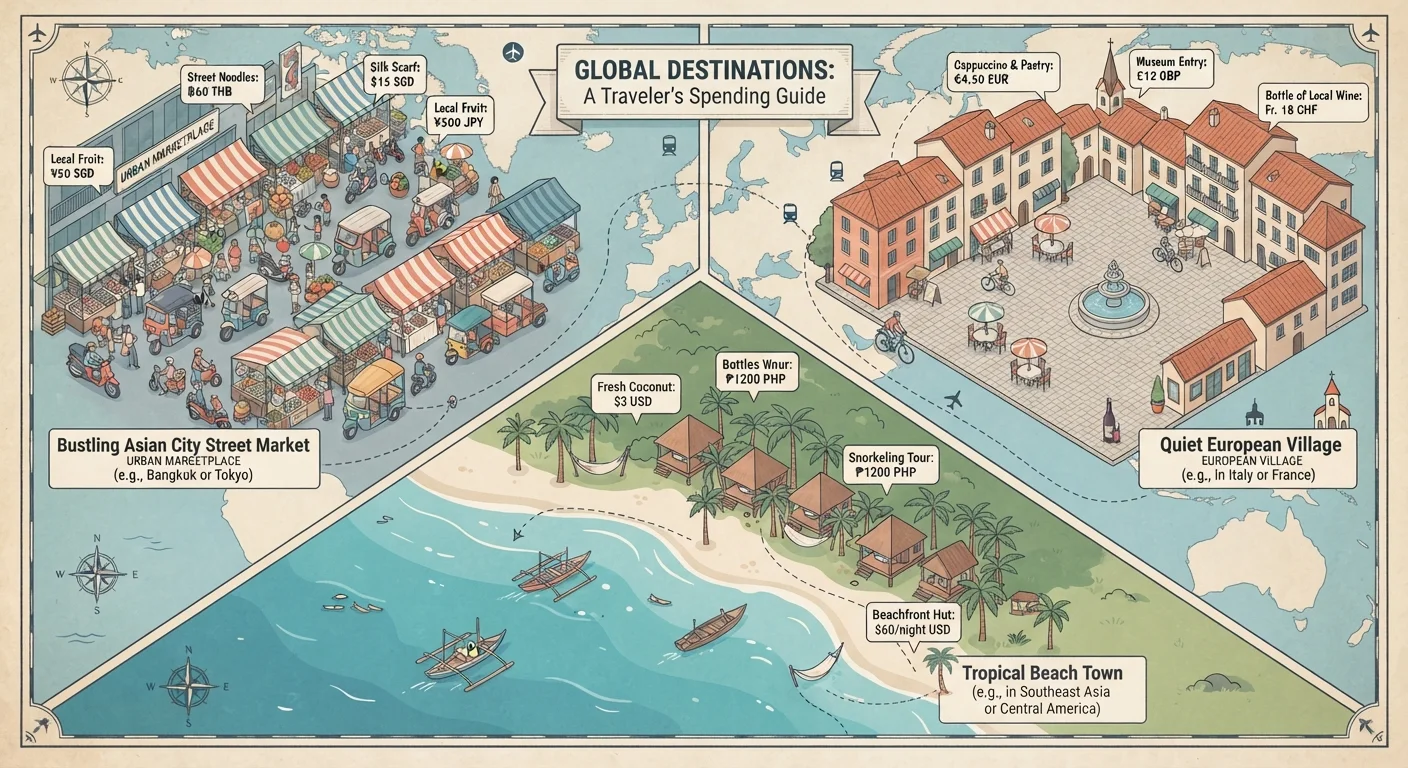
What Shapes the Price of a Destination
Travel costs aren't random. They follow patterns rooted in economics, geography, and tourism history. Before comparing flight prices or scrolling through accommodation listings, it helps to understand the forces that set the floor and ceiling on what you'll spend at any given destination.
The four primary cost drivers are:
- Local wage levels: In countries with higher median wages, hotels, restaurants, and tour operators pay staff more - and that cost passes to you. This is why Western Europe and Australia tend to run more expensive than Southeast Asia or Central America for equivalent service levels.
- Tourism infrastructure maturity: Destinations with well-developed tourism infrastructure - established hotel networks, reliable transport, clear pricing - often cost more because the convenience is built in and demand is high. Emerging destinations may offer lower prices but require more effort to navigate.
- Tourism density: High visitor volume creates price pressure across the board. Accommodations near major landmarks, restaurants in tourist centers, and guided tours at famous sites all carry premiums that their off-the-beaten-path equivalents don't.
- Currency and purchasing power: The relative value of the US dollar against local goods matters more than the nominal exchange rate. In some markets, a dollar buys several times what it does domestically; in others, it barely stretches further at all.
See our glossary of travel budget terms for definitions of purchasing power parity and other financial concepts that come up in destination research.
2-4×
Price range for similar accommodation across destination types
Cost-of-living databases consistently show that equivalent mid-range accommodation can cost two to four times more in high-income, high-tourism markets compared to emerging destinations.
40-80%
Seasonal price variation for the same accommodation
Industry analysts and travel booking platforms have documented peak-to-off-season price swings of 40-80% for identical properties at popular seasonal destinations.
30-50%
Savings from staying outside main tourist zones
Travelers who choose accommodation and dining options in non-tourist-facing neighborhoods of the same city frequently report spending 30-50% less than those staying in central tourist corridors.
How Destination Type Changes Your Daily Spend
Categorizing destinations by type gives you a practical shortcut for estimating costs before you dig into specifics.
Urban vs. Rural
Major cities - especially capital cities and financial hubs - carry higher baseline costs for accommodation and dining. Rural areas within the same country often cost 30-50% less for equivalent quality, though transportation to reach them adds its own expense.
Coastal and Resort Areas
Beach destinations and ski resorts operate on demand-based pricing during peak season. Accommodation rates can double or triple compared to shoulder season, and local businesses serving tourist traffic price accordingly. The convenience of an all-inclusive setting can actually simplify budgeting, though total spend is usually higher. How you choose to stay - hotel, vacation rental, or hostel - interacts directly with destination type and should be decided together.
Emerging vs. Established Destinations
Destinations that have recently attracted international tourism attention often sit in a transitional pricing window - infrastructure and tourism services exist, but competition keeps prices lower than in fully mature markets. This window closes as popularity grows, so cost profiles shift over time.
Reading the Cost Signals Before You Book
The goal isn't to find the cheapest destination - it's to understand what a destination actually costs so your budget reflects reality. A few concrete steps help you read cost signals early in planning.
Check average daily budget data. Travel communities and cost-of-living databases publish crowd-sourced daily spending averages broken down by accommodation, meals, and transport. These aren't guarantees, but they give you a calibrated baseline.
Price out accommodation directly. Run a search for your travel dates and note the median price for a standard private room or apartment in the neighborhoods you're considering. This single data point tells you more than any general country ranking.
Identify tourist-pricing zones. In most destinations, there's a clear geographic divide between where tourists pay and where locals pay. Identifying that boundary - and deciding which side of it you'll operate on - is one of the highest-leverage decisions in destination planning.
Account for seasonality. A destination's cost profile in peak season can look entirely different from its off-season profile. Prices for identical accommodation can vary by 40-80% depending on timing alone.
For a fuller picture of the line items most travelers overlook once they've settled on a destination, see our piece on the real cost of a trip. And if you want to understand where budgets tend to break down in practice, where travel budgets break down walks through the most common failure points.
Price Out Three Categories Before You Commit
Before finalizing a destination, look up current prices for a mid-range hotel night, a sit-down dinner for one, and a local transit day pass. These three data points together give you a reliable sense of the destination's cost tier and whether it fits your budget - faster than reading any general ranking or overview.