
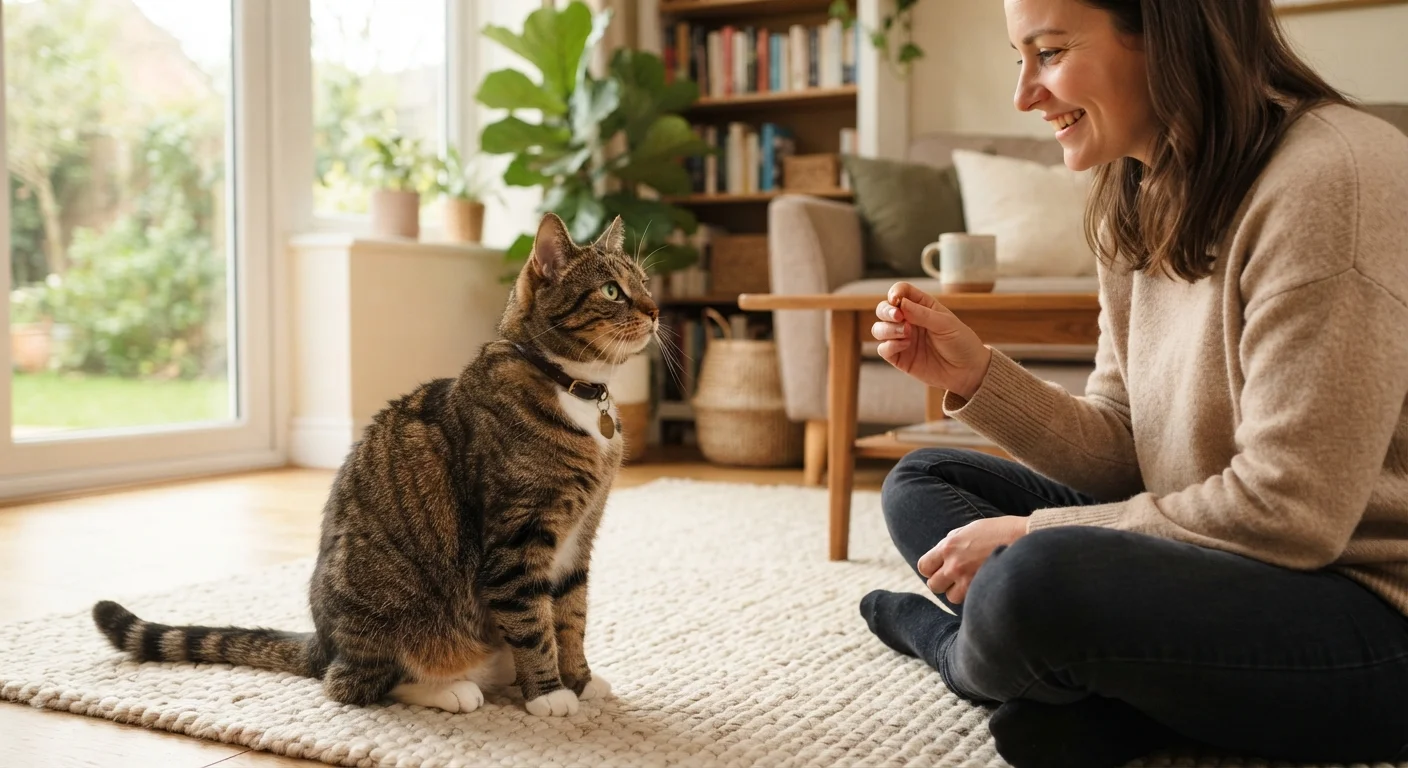
Why Recall Training Works for Cats
The notion that cats are untrainable is a myth rooted in a misunderstanding of feline learning. Cats are highly capable of learning through operant conditioning - the same mechanism that underpins dog training. They simply differ in motivation and attention span. Unlike dogs, most cats are not socially motivated by praise alone, which means food rewards and play are typically more effective reinforcers. Understanding this distinction is essential before starting.
Recall training is more than a parlor trick. A reliable come-when-called response can be genuinely useful in safety situations - calling a cat away from a hazard, locating a hidden or frightened pet, or facilitating an emergency exit. As explored in Training Across Species: Dogs, Cats, Rabbits, and Birds Compared, the underlying principles of positive reinforcement apply across species, even when the practical approach differs.
What you will need
Expect a learning curve that varies by individual cat. Age, temperament, and prior socialization all influence how quickly a cat picks up new behaviors - but nearly all cats can learn recall with a patient, consistent approach.
What to Avoid During Training
Common mistakes can set back training significantly. The most damaging is using the recall cue to bring your cat toward something it dislikes - administering medication, trimming nails, or putting it in a carrier. Cats form associations quickly; if the cue predicts an unpleasant experience even once or twice, the response will weaken. Reserve a separate, neutral cue for necessary but less welcome events.
Never Use Recall for Unpleasant Events
Calling your cat to administer medication, bathe it, or place it in a carrier will erode the positive association you've worked to build. Once a cat learns the recall cue predicts something aversive, recovery takes considerably longer than the time saved. Use a separate, neutral approach for necessary but unwelcome events.
Equally important: avoid punishment of any kind when your cat doesn't respond. A cat that is scolded or grabbed after hesitating to come will associate the cue - and approaching you - with a negative outcome. Every interaction around the recall cue should be reliably positive. Keep sessions to 2-5 minutes, end before your cat shows signs of disengagement (looking away, grooming, walking off), and always close with a successful repetition followed by a reward.
Patience is not optional in cat training - it is the method. Short, frequent sessions across several weeks consistently outperform long, infrequent ones.