Why Pet Food Labels Are Harder to Read Than They Look
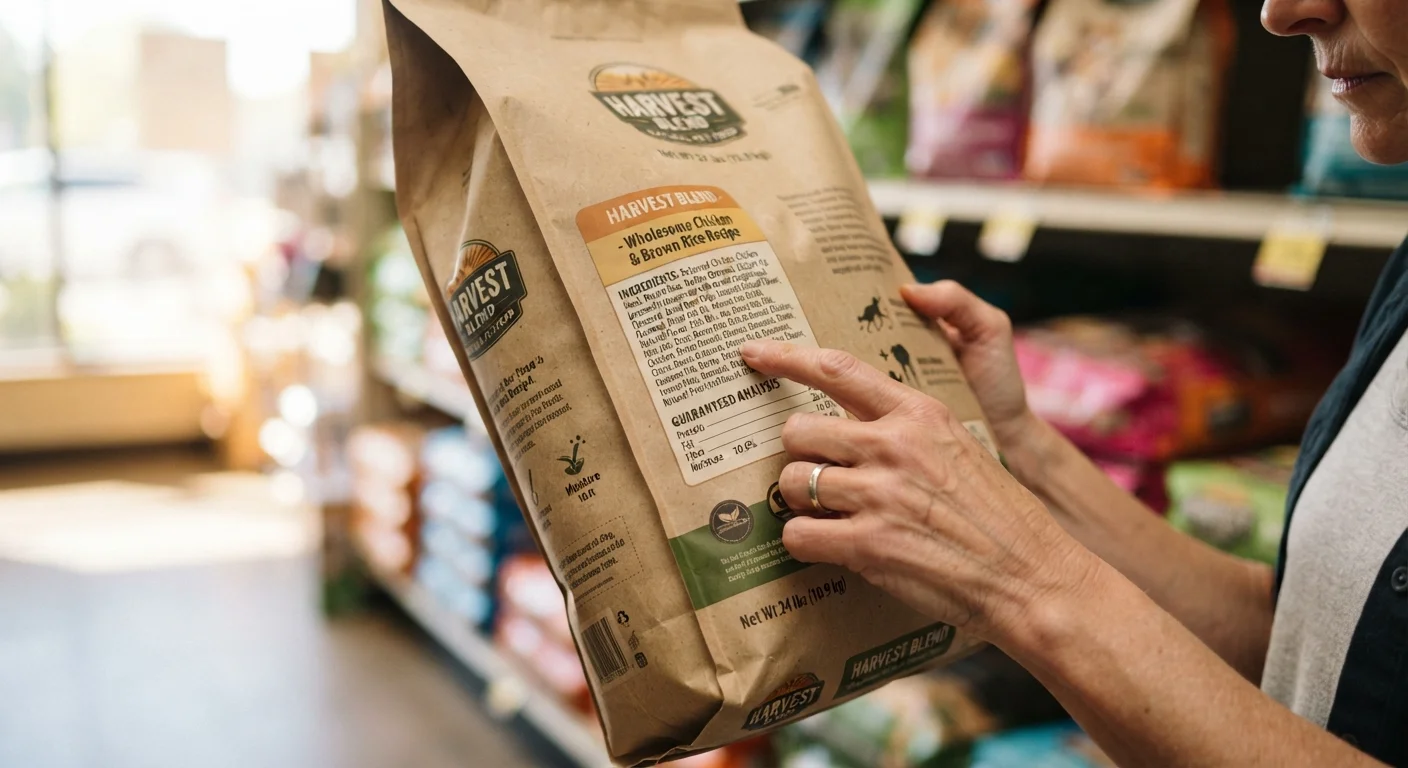
Pet food packaging is designed to sell, not to educate. Vibrant imagery, bold claims, and ingredient call-outs compete for your attention, while the genuinely useful information is printed in small type on the back or side panel. Understanding the structure of a label - what is regulated, what is loosely defined, and what is pure marketing - puts you in a much stronger position when choosing what to feed your pet.
In the United States, pet food labeling is governed primarily by the AAFCO model regulations, which individual states adopt into law. The FDA also has authority over pet food safety and labeling accuracy. Together, these bodies require that labels include six core elements: a product name, net weight, manufacturer contact information, a guaranteed analysis, an ingredient list, and a nutritional adequacy statement. Everything else - the lifestyle photography, the "grain-free" badge, the chef's hat on the logo - is optional and largely unregulated.
For a broader foundation on pet nutrition before diving into label mechanics, see our introduction to pet nutrition basics.
What you will need
Step-by-Step: How to Evaluate a Pet Food Label
Work through a label in the order below. Each step builds on the last, so resist the urge to start with the ingredient list - that is step three for a reason.
Locate the AAFCO Nutritional Adequacy Statement
This is the most important sentence on the label. It will read something like: "[Product name] is formulated to meet the nutritional levels established by the AAFCO Dog Food Nutrient Profiles for all life stages." Look for two things: the method used (formulated to meet nutrient profiles, or substantiated by a feeding trial) and the life stage covered (growth/reproduction, adult maintenance, all life stages, or "complementary/intermittent" - meaning the food is not nutritionally complete on its own).
Feeding trial substantiation is generally considered a higher standard of evidence than formulation alone, though both are legally acceptable. A food labeled "complementary" or "intermittent" should not be the sole diet for your pet.
Check That the Life Stage Matches Your Pet
AAFCO recognizes distinct nutritional profiles for growth and reproduction (puppies, kittens, pregnant or nursing animals) and adult maintenance. "All life stages" meets the more demanding growth standard and is appropriate for any pet. "Adult maintenance" is not appropriate as the sole diet for a growing puppy or kitten. Confirm the stated life stage aligns with your pet's current needs before going further.
Read the Ingredient List Critically
Ingredients are listed in descending order by weight before cooking. This matters because high-moisture ingredients like fresh chicken or beef weigh more before processing and may rank highly on the list, yet contribute less protein on a dry weight basis than a concentrated meal ingredient listed lower down. "Chicken meal," for instance, is a rendered, moisture-removed ingredient that delivers more protein per gram than fresh chicken.
Watch for ingredient splitting - a practice where a single ingredient (e.g., peas) appears multiple times under different names (pea protein, pea starch, pea fiber), which can push it lower on the list than its combined contribution would suggest. Our in-depth ingredient list guide covers these mechanics in greater detail.
Review the Guaranteed Analysis with Context
Note the crude protein minimum, crude fat minimum, crude fiber maximum, and moisture maximum. If you are comparing a wet food to a dry food, convert both to a dry matter basis before drawing conclusions (see the section below for the calculation). Remember these are guaranteed limits, not exact values - actual nutrient levels can vary batch to batch within regulatory tolerances.
Note the Manufacturer Contact Information
Regulations require a responsible party's name and address. A manufacturer willing to list a direct phone number or email and respond to detailed nutritional questions is generally a positive sign of transparency. You can ask about the food's nutrient profile on a dry matter basis, quality control practices, and whether feeding trials were conducted. The answers (or non-answers) are informative.
Understanding the Guaranteed Analysis Panel
The guaranteed analysis lists minimum percentages for crude protein and crude fat, and maximum percentages for crude fiber and moisture. These are regulatory floors and ceilings, not precise measurements of what is actually in every bag or can. Two foods with identical guaranteed analysis values can differ meaningfully in actual nutrient profiles.
One important nuance: comparing guaranteed analysis figures across wet and dry foods is not straightforward. Wet food typically contains 70-80% moisture, which dilutes the percentages. To compare them meaningfully, nutritionists use a dry matter basis calculation - dividing each nutrient percentage by the percentage of dry matter (100 minus moisture %). For example, a wet food listing 10% protein with 78% moisture has roughly 45% protein on a dry matter basis, which is quite high. Most veterinary nutrition resources explain this conversion in detail.
Converting to Dry Matter Basis
To convert a guaranteed analysis nutrient to dry matter basis, divide the listed percentage by (100 minus the moisture percentage), then multiply by 100. For example: 10% protein ÷ (100 − 78% moisture) = 10 ÷ 22 × 100 ≈ 45% protein on a dry matter basis. This calculation makes wet and dry foods directly comparable.
For a practical audit of whether your pet's current diet is truly balanced, our diet completeness checklist is a useful companion tool.
What to Ignore on the Front of the Package
Several terms that appear prominently on pet food packaging have no standardized regulatory definition in the United States and should not drive purchasing decisions on their own:
- "Natural" - AAFCO does provide a definition (no chemically synthetic ingredients), but it does not imply nutritional superiority or safety.
- "Premium" or "Ultra-Premium" - No regulatory definition exists. Any manufacturer may use these terms regardless of ingredient quality.
- "Human-grade" - Unless the entire product is manufactured in a facility licensed for human food production and distributed under the same standards, this term is largely unverified marketing language.
- "Grain-free" - Describes what is absent, not what is present. The FDA investigated a potential association between grain-free diets and dilated cardiomyopathy in dogs; research is ongoing and inconclusive. See our science-based overview of grain-free diets for more context.
Marketing Language Is Not a Nutritional Guarantee
Terms like "premium," "holistic," and "human-grade" are not defined or enforced by AAFCO or the FDA in a way that guarantees nutritional quality or safety. Relying on these terms without checking the regulated sections of the label may lead you to overlook foods that are genuinely well-formulated - or to overestimate foods that are not.
Front-of-pack claims are best treated as conversation starters, not conclusions. Let the regulated sections of the label - the AAFCO statement, guaranteed analysis, and ingredient list - do the real work.