
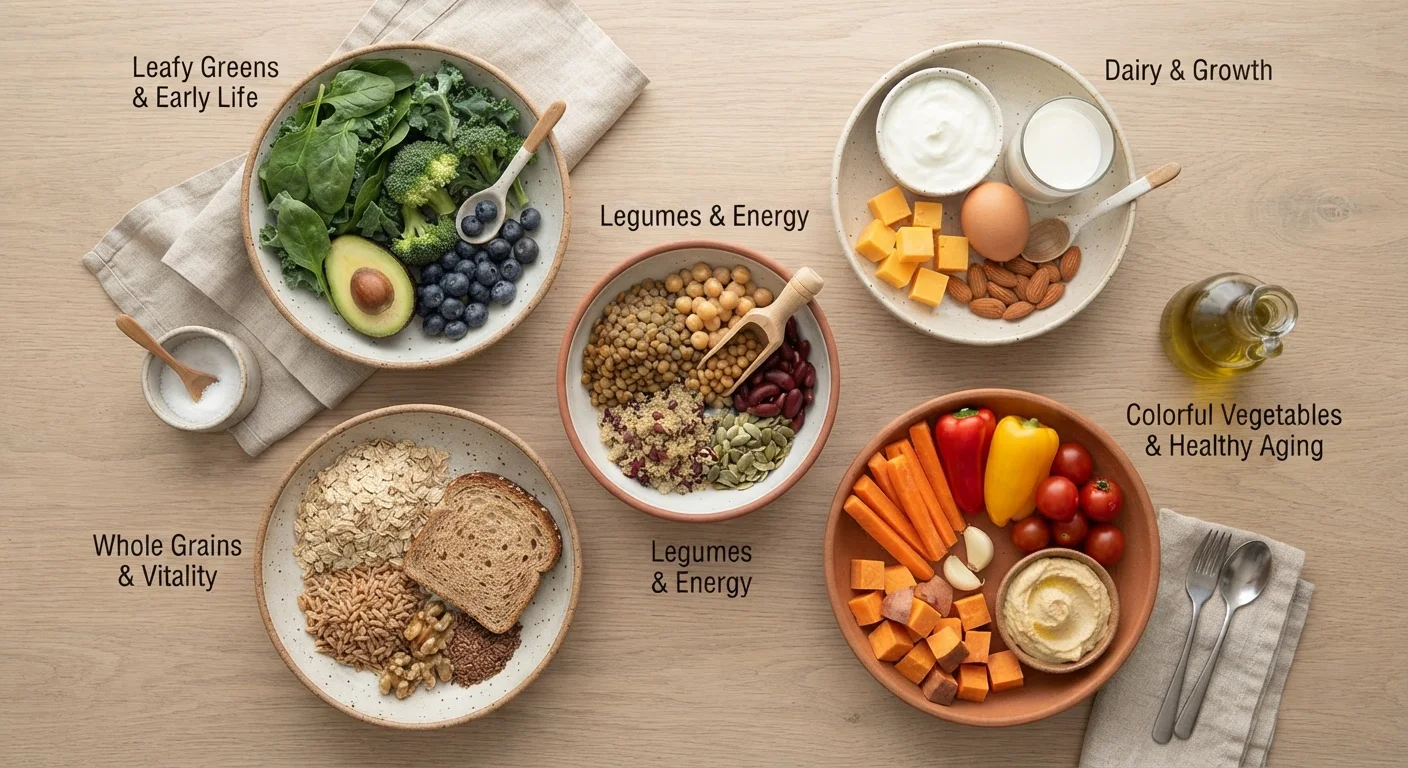
Why Nutritional Needs Aren't Fixed
Nutrition is often discussed as though a healthy adult has one universal set of requirements. In reality, the body's demands shift continuously across the lifespan. Hormonal changes, shifts in metabolic rate, changes in gut absorption efficiency, and evolving disease risk all influence what nutrients matter most - and in what amounts - at different life stages.
Understanding these patterns isn't about following a rigid plan; it's about knowing which levers tend to matter as the decades pass. For a broader look at foundational eating principles that apply regardless of age, see building a nutritionally balanced plate.
~10%
Decline in metabolic rate per decade after 20s
Research suggests resting metabolic rate declines roughly 1-2% per decade in adults, with lean muscle loss being a primary driver.
1,200 mg
Daily calcium recommendation for women over 50
According to the National Institutes of Health Office of Dietary Supplements, the recommended daily allowance for calcium rises after menopause.
~90%
US adults not meeting fiber recommendations
The Dietary Guidelines Advisory Committee has consistently noted fiber as a nutrient of public health concern due to widespread under-consumption.
40%+
US adults with insufficient vitamin D levels
Estimates from national survey data suggest a substantial portion of US adults have suboptimal vitamin D status, across all age groups.
Your 20s: Building the Foundation
The twenties represent a critical window for establishing the nutritional habits that will pay dividends for decades. Bone density peaks around age 30, making adequate calcium (found in dairy, fortified plant milks, leafy greens, and tofu) and vitamin D especially important during this decade. Iron needs remain elevated, particularly for women who menstruate.
Energy requirements are typically at their highest in young adulthood, driven by metabolic rate and often by physical activity levels. However, high caloric availability can mask poor diet quality - it's possible to consume plenty of food while under-consuming fiber, micronutrients, and healthy fats. Establishing a varied, whole-food-leaning pattern now creates habits and nutrient stores that the body will draw on later.
Think of your 20s as a savings account for bone health - the deposits you make through calcium and weight-bearing activity now determine the balance you'll draw on after 50.
Peak bone mass is largely established by age 30; inadequate intake in early adulthood is difficult to fully compensate for later, making this a high-impact window.
When reviewing your diet across any decade, prioritize food variety over supplementation - whole foods deliver nutrients in combinations that isolated supplements cannot fully replicate.
Nutrients in whole foods interact synergistically; for example, vitamin C in vegetables enhances non-heme iron absorption from plant foods, a benefit not guaranteed from isolated supplements.
Your 30s and 40s: Protecting What You've Built
Metabolic rate begins a gradual decline starting in the mid-to-late 30s, partly driven by a natural reduction in lean muscle mass - a process called sarcopenia (age-related muscle loss). Protein intake becomes increasingly relevant as a tool for slowing this process when paired with resistance activity. Most evidence supports distributing protein intake across meals rather than concentrating it in one sitting.
For many adults, the 30s and 40s also bring increased life demands - career pressures, caregiving, disrupted sleep - that can affect appetite, food choices, and nutrient status. Folate (vitamin B9) remains important for women of reproductive age. Magnesium, often under-consumed, plays roles in energy metabolism, blood sugar regulation, and sleep quality. Common misconceptions about macronutrients and food groups can lead to unnecessary dietary restrictions; separating nutrition myths from evidence is worthwhile at this stage.
Your 50s: Navigating Hormonal and Metabolic Shifts
The 50s mark some of the most significant nutritional inflection points in adult life. For women, menopause brings a sharp decline in estrogen that accelerates bone density loss and alters cardiovascular risk profiles. Calcium recommendations increase to 1,200 mg per day for women over 50 (from 1,000 mg), according to the National Institutes of Health. Vitamin D requirements also rise, supporting both bone health and immune function.
Metabolic rate continues to decline, but protein needs do not decrease - they may actually increase to offset the reduced efficiency of muscle protein synthesis that accompanies aging. Fiber intake supports digestive regularity, cholesterol management, and stable blood sugar, all of which become more relevant in this decade. Men are not exempt from these shifts; testosterone declines gradually from middle age onward, with related effects on muscle mass and metabolic health.
Don't Self-Diagnose Nutrient Deficiencies
Symptoms like fatigue, hair loss, or brain fog can have many causes, only some of which are nutrition-related. Assuming a deficiency and self-supplementing without testing can lead to excessive intake of some nutrients while missing the actual underlying issue. A blood panel ordered by your healthcare provider is the appropriate first step.
Your 60s and Beyond: Prioritizing Density Over Volume
Appetite often decreases with advancing age, influenced by slower gastric emptying, changes in taste and smell, medication effects, and reduced physical activity. The practical nutritional challenge shifts from managing excess intake to ensuring sufficient nutrient density within a smaller total food volume.
Vitamin B12 absorption declines as the stomach produces less intrinsic factor and hydrochloric acid - both needed for B12 extraction from food. The NIH notes that adults over 50 are encouraged to meet much of their B12 need through fortified foods or supplements, since these forms don't require stomach acid for absorption. Potassium, found in fruits, vegetables, legumes, and dairy, supports blood pressure regulation and heart health. Adequate hydration is critical, yet thirst perception becomes less reliable - older adults may become dehydrated before feeling thirsty. For more on how water interacts with nutrient absorption and metabolism, see hydration and nutrition.
Nutrients That Matter Across Every Decade
While priorities shift, several nutrients remain consistently important throughout adult life:
- Fiber: Supports gut health, blood sugar regulation, and cholesterol levels at every age. Most US adults consume well below recommended amounts.
- Omega-3 fatty acids: Found in fatty fish, flaxseed, and walnuts; associated with cardiovascular and cognitive health across decades.
- Potassium: Supports heart function and blood pressure; often under-consumed relative to sodium in typical US diets.
- Vitamin D: Critical for bone health and immune function; many adults have insufficient levels regardless of age.
- Magnesium: Involved in hundreds of enzymatic reactions; under-consumed across all adult age groups.
Diet quality - not any single nutrient - remains the dominant factor in long-term health outcomes. Whole, minimally processed foods tend to deliver nutrients in forms the body uses efficiently and in combinations that work synergistically.
When to Talk to a Healthcare Professional
General nutrition information provides useful context, but individual needs vary considerably based on health status, medications, genetics, activity level, and life circumstances. A registered dietitian nutritionist (RDN) can translate population-level evidence into personalized, practical guidance. A primary care provider can order labs to identify actual nutrient deficiencies - rather than relying on guesswork - and can factor in medications that affect absorption or nutrient metabolism.
This article is intended as general health information and education, not medical or dietary advice. For guidance tailored to your specific health situation, please consult a qualified healthcare professional.
This article is for informational purposes only and does not constitute medical or nutritional advice. Individual nutritional needs vary. Please consult a qualified healthcare professional - such as a registered dietitian or your primary care provider - before making significant changes to your diet, particularly if you have an existing health condition or take medications.