How Each Method Builds Strength
Strength training works by placing muscles under sufficient load to stimulate adaptation - a principle covered in depth in our article on progressive overload and fitness gains. Both bodyweight exercises and gym machines can satisfy this requirement, just through different mechanisms.
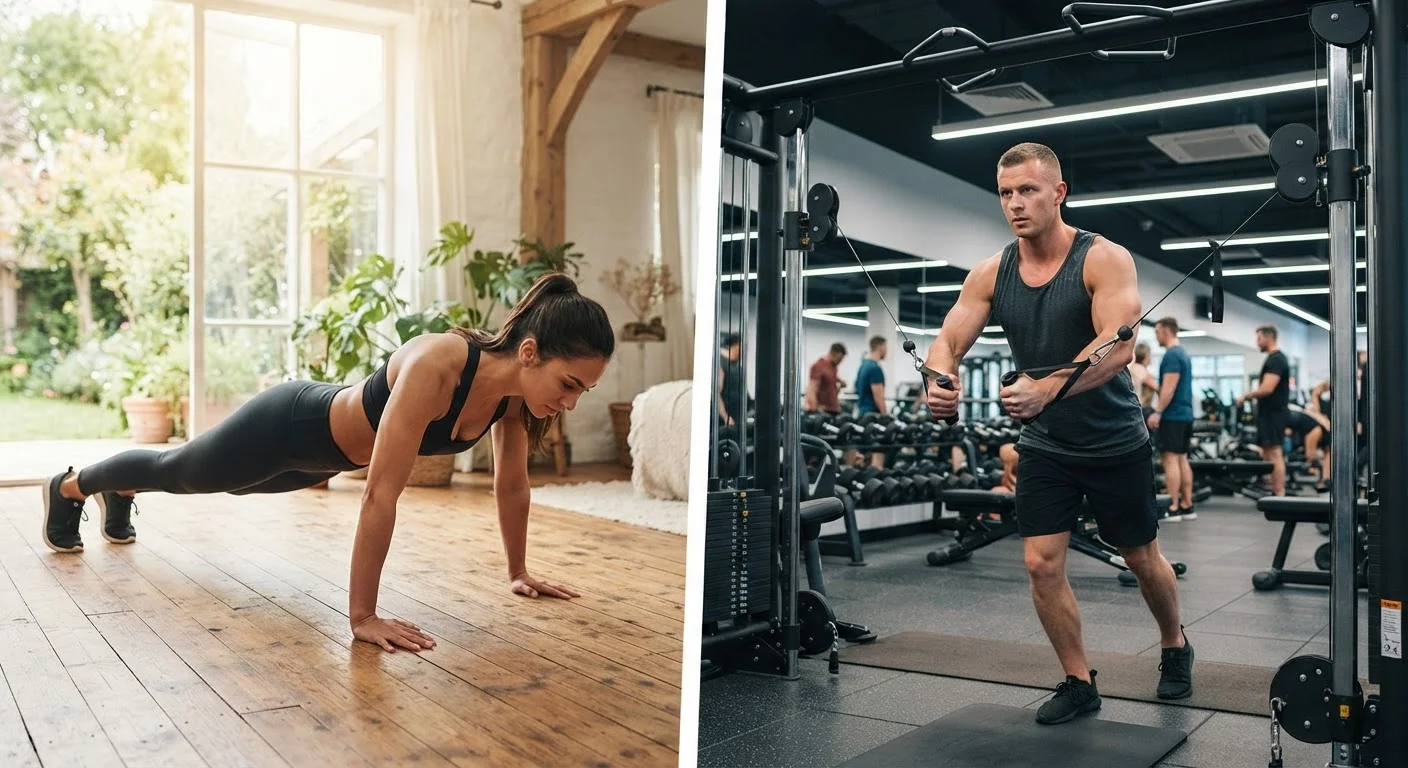
Bodyweight training uses the mass of your own body as resistance. Exercises like push-ups, pull-ups, squats, lunges, and planks engage multiple muscle groups simultaneously, often requiring significant coordination and core stability. Difficulty can be scaled by adjusting leverage (e.g., elevating feet for push-ups), tempo, or exercise variation - though adding resistance beyond your bodyweight does eventually require creativity or supplemental equipment.
Gym machines deliver resistance through weighted stacks, cables, or pneumatic systems along a fixed or guided path. This makes load increments easy to track and adjust, and reduces the coordination demands of each movement. Machines isolate specific muscles effectively, which can be useful during rehabilitation or when targeting a lagging muscle group.
| Bodyweight Training | Gym Machines | |
|---|---|---|
| Cost | Free or minimal | Membership or equipment fees |
| Accessibility | Anywhere, anytime | Requires gym or home equipment |
| Progression clarity | Less quantifiable | Easily measurable load increments |
| Muscle isolation | Limited; multi-joint focus | High; targets specific muscles |
| Functional carry-over | Generally strong | Varies by exercise |
| Beginner-friendliness | Moderate; some skill needed | High; guided movement path |
| Injury risk | Low with good form | Low; reduced stabilizer demand |
Practical Differences That Matter Day to Day
Beyond the physiological mechanics, several practical factors shape the real-world experience of each approach.
Accessibility and cost favor bodyweight training significantly. No membership, equipment purchase, or commute is required. Workouts can happen in a living room, park, or hotel room. Gym machines, by contrast, require access to a facility - typically involving ongoing membership costs and scheduling around hours of operation.
Learning curve differs considerably. Machines guide the range of motion, which can help beginners learn movement patterns with reduced injury risk and less need for immediate coaching. Bodyweight movements - particularly advanced progressions like handstands or pistol squats - demand greater kinesthetic awareness and may benefit from instruction to execute safely.
Progression is more transparent on machines: adding five pounds to a weight stack is measurable and repeatable. Bodyweight progression is less linear. Transitioning from a standard push-up to an archer push-up represents a meaningful increase in difficulty, but the load change is harder to quantify precisely.
Combining Both Methods Has Merit
You don't have to choose exclusively between bodyweight training and gym machines. Many experienced exercisers use bodyweight movements to build foundational stability and mobility, then use machines for targeted load work. Mixing formats can address gaps that either approach alone may leave - and can help sustain variety and motivation over time.
What Research Suggests About Outcomes
Studies comparing resistance training modalities generally find that muscle hypertrophy (growth) and strength development are driven primarily by training volume, intensity, and consistency - not the specific format. Research published in exercise science literature supports the view that free weights, machines, and bodyweight exercises can all produce comparable results when volume and effort are equated.
Where differences emerge tends to be in specificity. Gym machines may produce faster early gains in isolated muscle strength, while bodyweight training often shows stronger carry-over to functional, real-world movement patterns. Neither finding is absolute, and individual responses vary considerably.
For those interested in how strength training compares to cardiovascular exercise more broadly, our overview of cardio vs. strength training research provides useful context.
Choosing What Works for You - and Sticking With It
Ultimately, the most effective training method is one you will actually sustain. Adherence is the variable that most consistently predicts long-term outcomes in fitness research. A gym machine routine abandoned after three weeks delivers far less benefit than a modest bodyweight routine maintained for months.
Consider starting with whichever format feels more accessible and enjoyable. Many people find value in combining approaches - using bodyweight movements for warm-ups, mobility work, or travel days, while leveraging machines for targeted strength work when gym access is available.
If you've struggled to maintain a routine in the past, understanding the structural reasons why routines fail can be as valuable as choosing the right exercises. Our piece on why fitness routines fall apart explores the patterns worth knowing before you begin.
This article is for general informational and educational purposes only and is not a substitute for professional medical or fitness advice. Consult a qualified healthcare provider or certified fitness professional before beginning a new exercise program, particularly if you have an existing health condition or injury.