
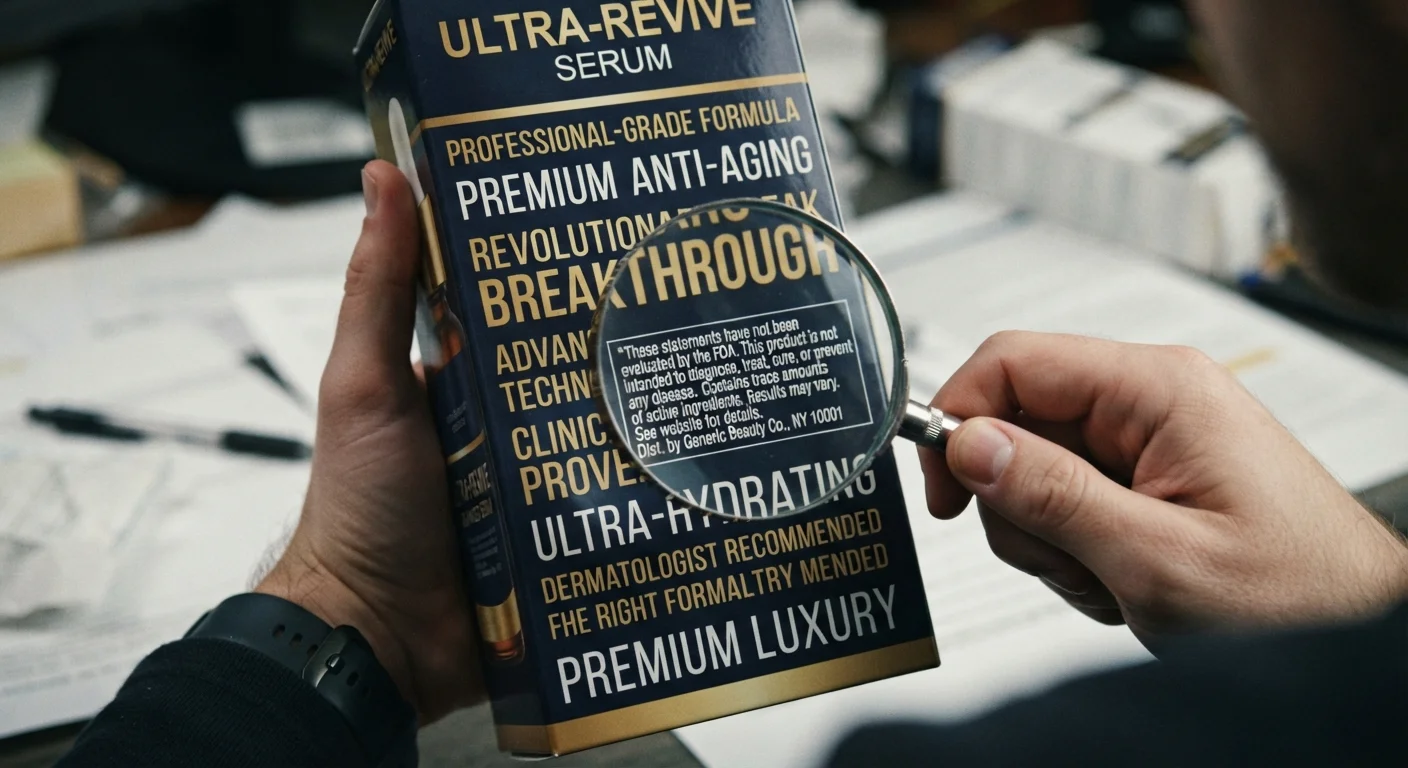
Why Marketing Language Exists in a Gray Zone
When a package says a product is "professional-grade" or "advanced," most shoppers instinctively assume these words mean something concrete. They don't - at least not in any standardized, legally enforceable sense across most product categories. Manufacturers use aspirational adjectives precisely because they create impressions without triggering the kind of scrutiny that comes with testable, quantifiable claims.
This isn't accidental. Marketing language occupies a deliberate gray zone: specific enough to influence purchasing decisions, vague enough to avoid liability. The Federal Trade Commission (FTC) regulates certain categories of claims - environmental terms like "recyclable" or weight-loss representations, for example - but broad quality descriptors like "premium" or "superior" fall largely outside enforceable standards in most contexts.
Understanding this gap is the starting point for smarter shopping. Once you recognize that adjectives on packaging are rarely definitions, you start asking the right questions: Compared to what? Measured how? Verified by whom?
Myth
If a product is labeled 'premium,' it must meet a higher quality standard than standard versions.
Fact
"Premium" is a marketing descriptor with no standardized definition in most product categories. It signals price positioning, not verified quality.
Manufacturers self-apply the word "premium" without any regulatory threshold to meet. It is a positioning term designed to justify a higher price point and create a perception of superiority. When evaluating whether a product is genuinely higher quality, look instead at verifiable specifications, material composition data, or independent testing results - not the label's adjective choices.
Myth
"Clinically tested" on a product means the formula or design has been scientifically proven to work.
Fact
"Clinically tested" only confirms that some form of study was conducted. It does not indicate the study found positive results, was peer-reviewed, or met any particular scientific standard.
The phrase is deliberately chosen for its scientific ring rather than its informational content. A product can be "clinically tested" by a study that found no significant benefit - and still legally use the phrase. Consumers should look for "clinically proven" language accompanied by citations to published, peer-reviewed research, and even then should consider the study's sample size and independence from the manufacturer.
Note: This is general consumer information, not medical or health advice. Consult a qualified healthcare professional for guidance on health-related product decisions.
Myth
"Professional-grade" products are the same tools or materials that licensed professionals actually use on the job.
Fact
"Professional-grade" is a marketing designation, not an industry certification. Actual professional equipment typically carries documented performance standards or trade-body certifications.
Genuine professional-use equipment is often characterized by specific load ratings, IP (Ingress Protection) certifications, UL listings, or compliance with OSHA or industry-body standards - not self-applied adjectives. When a manufacturer applies "professional-grade" to a consumer product, they are borrowing the credibility of professional standards without meeting them. Ask specifically what certification or standard backs the claim.
Myth
"New and improved" or "advanced formula" means the product has been substantially upgraded based on new research.
Fact
These phrases require no minimum change threshold and are frequently applied after minor reformulations or packaging updates.
There is no regulatory requirement specifying how significant a change must be before a product can be called "improved" or "advanced." A minor ingredient swap, a packaging redesign, or even a fragrance adjustment can technically support the label. When a meaningful upgrade matters - in tools, appliances, or health products - look for version-specific documentation from the manufacturer explaining what changed and by what measurable degree.
Myth
If a claim appears in a major retail advertisement, it has been vetted for accuracy before publication.
Fact
Retailers and media platforms are generally not responsible for verifying the factual accuracy of manufacturer-supplied marketing claims.
The burden of truth in advertising falls primarily on the advertiser, not the platform or retailer. While the FTC can take action against demonstrably false or deceptive claims, aspirational or vague language rarely triggers enforcement. Retailers display manufacturer content largely as provided. This means the consumer - not the channel - bears responsibility for independently verifying meaningful claims before purchase.
The Most Common Buzzwords - and What They Actually Signal
Certain words appear across virtually every product category with remarkable consistency. Recognizing them as category signals rather than quality guarantees reframes how you evaluate a purchase.
- "Professional-grade" / "Pro": Often signals that a product is positioned at a higher price tier, not that it meets any trade or industry certification. Actual professional tools frequently carry documented performance ratings, load tolerances, or third-party certifications - marketing copies the vocabulary without the verification.
- "Advanced" / "Next-generation": Implies improvement over a prior version but rarely specifies what changed or by how much. Look for changelog documentation or independent testing that quantifies the advancement.
- "Premium": One of the most structurally empty words in retail. It communicates price positioning, not material quality, durability, or performance benchmarks.
- "Clinically tested" vs. "clinically proven": These are not equivalent. "Tested" means a study was conducted - it says nothing about the outcome. Always ask whether results were peer-reviewed and published.
For a deeper look at how these dynamics play out in automotive retail specifically, see the terminology guide for car lots and finance offices - dealers deploy similar language strategies around trim levels, packages, and financing terms.
~1 in 3
Consumers misled by vague "natural" label claims
Consumer Reports surveys have found that a significant share of US shoppers incorrectly believe that unregulated terms like "natural" on food and personal care products carry a government-defined standard.
No limit
Products that can self-apply "premium" label
In most US consumer product categories, there is no federal regulatory threshold a product must meet before a manufacturer can legally use the word "premium" on its packaging.
Moving From Adjectives to Evidence
The practical antidote to vague marketing language is a shift from adjective evaluation to specification evaluation. Every credible performance claim should be traceable to a number, a standard, or a third-party test - not a descriptor.
When researching any major purchase, apply this three-question filter to any marketing claim:
- What does this word actually measure? If the answer is "nothing specific," the word is decorative, not informative.
- Who verified it? First-party claims (the manufacturer testing its own product) carry far less evidentiary weight than third-party lab tests, independent certifications, or peer-reviewed studies.
- What's the comparison baseline? "Better" and "improved" are meaningless without a specified comparison point.
Our guide on reading product specification sheets walks through how to extract the numbers that actually matter and ignore the ones that are engineered to impress rather than inform.
Warranties are another area where language precision matters enormously. Vague coverage terms like "comprehensive" or "full protection" are as unreliable as "premium" on a label. See common red flags in warranty fine print for the specific clauses that quietly limit your actual coverage.
Vague Warranty Language Mirrors Vague Marketing Language
Terms like "comprehensive coverage" and "full protection" in warranty documents carry the same evidentiary weight as "premium" on a label - which is to say, very little on their own. Before finalizing any major purchase, read the warranty's actual exclusions, not just its headline descriptors. Pay specific attention to what is explicitly excluded rather than what is broadly promised.