
The Problem Diversification Is Designed to Solve
Imagine putting all your savings into shares of a single company. If that company performs well, you benefit fully. But if it collapses - due to fraud, poor management, or a shift in its industry - your savings go with it. This is concentration risk: the danger of being too exposed to any one investment.
Diversification addresses this by distributing your money across multiple holdings. If one position loses value, the others may compensate. The underlying logic relies on the fact that different assets don't always respond identically to the same economic events. A tech sector downturn, for example, might leave utility stocks or government bonds relatively unaffected.
To understand how different assets behave individually before combining them, see our guide to stocks, bonds, and cash.
~20-30
Stocks needed to meaningfully reduce unsystematic risk
Academic research in portfolio theory, including foundational work by Edwin Elton and Martin Gruber, has suggested that a portfolio of roughly 20-30 uncorrelated stocks can significantly reduce company-specific risk, though this figure varies by study and methodology.
~0.9+
Correlation between major asset classes during 2008 crisis
Studies of the 2008 financial crisis found that correlations between traditionally uncorrelated assets rose sharply during the downturn, illustrating that diversification's protective effect diminishes in systemic market stress.
What 'Spreading Risk' Actually Looks Like
Genuine diversification operates on several levels simultaneously:
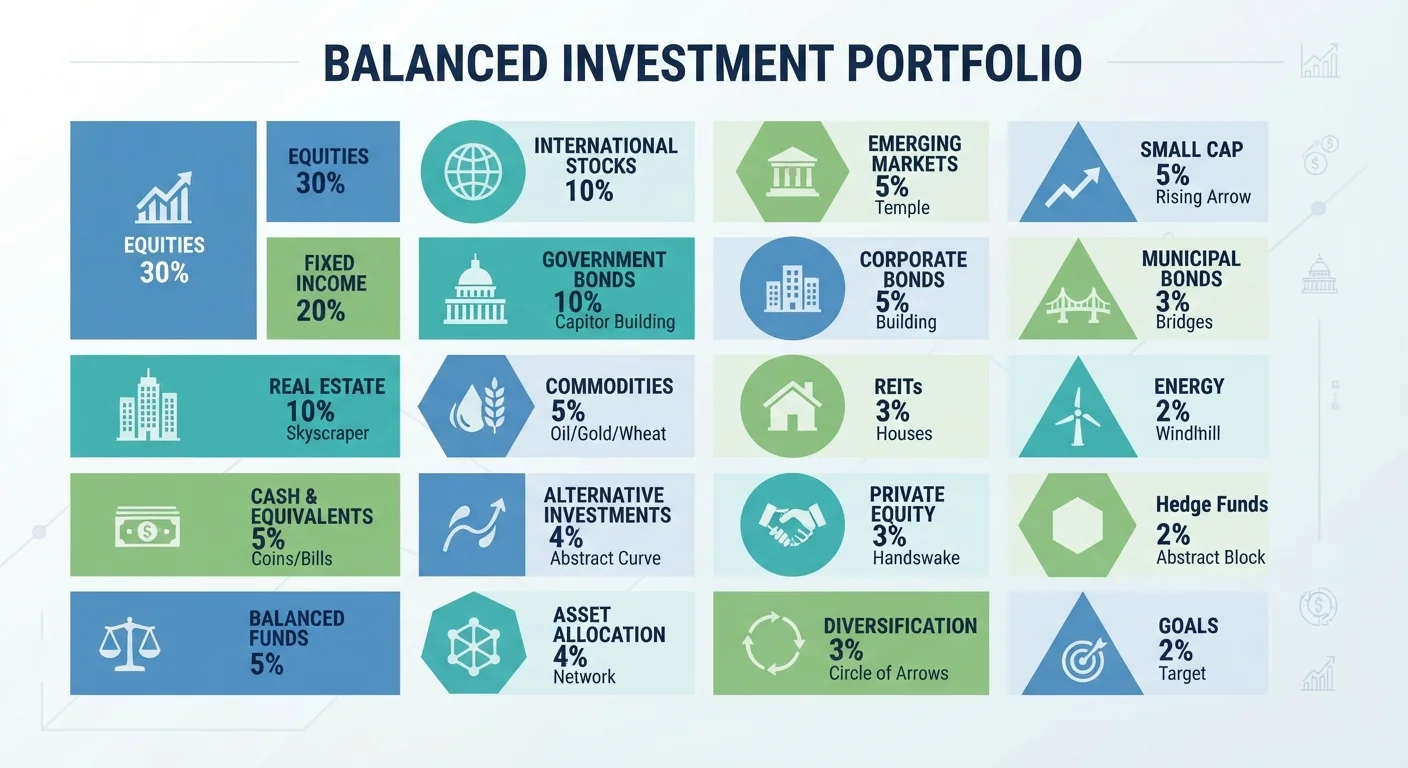
- Asset classes: Holding a mix of equities, fixed-income instruments, and cash equivalents rather than putting everything into one type.
- Sectors: Within equities, owning shares across healthcare, energy, technology, consumer goods, and other industries - not just one sector you feel confident about.
- Geographies: Including international and emerging-market exposure alongside domestic holdings, so your portfolio isn't entirely dependent on one country's economy.
- Time horizons: Staggering bond maturities, for instance, so you aren't fully exposed to interest rate changes at a single moment.
A common misconception is that owning multiple mutual funds automatically creates diversification. If those funds hold largely the same underlying securities, you've added complexity without meaningfully reducing concentration. Common investing misconceptions like this one can silently undermine a portfolio's structure.
The Hard Limits: What Diversification Cannot Do
Diversification manages what investment professionals call unsystematic risk - risk specific to a company, sector, or region. What it cannot manage is systematic risk, also called market risk: the risk that affects the entire market or broad economy at once.
During the 2008 financial crisis and the sharp market declines of early 2020, nearly every major asset class fell together. A diversified portfolio would still have lost value - though potentially less than a concentrated one. In extreme market conditions, the correlations between assets tend to increase, meaning the protective effect of diversification weakens exactly when it's most needed.
Other limits worth noting:
- Diversification does not improve the quality of individual holdings. Spreading across many poor-quality assets still leaves you with a portfolio of poor-quality assets.
- It does not protect against inflation eroding purchasing power across an entire portfolio.
- Currency risk, political risk, and regulatory changes can affect internationally diversified holdings in ways that are difficult to anticipate.
Check for Overlap Before Adding More Funds
Before assuming you're diversified, review the top holdings of each fund or investment you own. Many index funds and actively managed funds hold the same large-cap stocks. If your holdings overlap substantially, adding another similar fund won't meaningfully reduce your concentration risk - it will only add complexity.
Putting It Into Practice
How much diversification is appropriate depends heavily on your individual circumstances - your timeline, income stability, financial goals, and comfort with volatility. These factors are collectively described as risk tolerance, and they should shape how you distribute holdings across asset classes and sectors.
If you're new to investment terminology, our glossary of key investing terms can help you build a working vocabulary before evaluating any portfolio strategy.
The practical goal isn't to own the maximum number of investments - it's to hold assets that serve different roles and respond differently to market conditions. Start by understanding what you own and why, then assess whether your current holdings genuinely represent different types of risk exposure or merely the appearance of variety.
This article is for general informational and educational purposes only. It does not constitute personalised financial, investment, or tax advice. For guidance specific to your situation, consult a qualified, licensed financial adviser.