
How High-Yield Savings Accounts Work
At their core, high-yield savings accounts operate identically to standard savings accounts: you deposit money, the bank pays you interest on that balance, and you can withdraw funds when needed. The key distinction is the interest rate - measured as APY - which is often dramatically higher than what traditional brick-and-mortar banks offer.
Most HYSAs are offered by online banks, credit unions, or the online divisions of larger financial institutions. Because these providers carry lower overhead costs than physical branch networks, they can return more of their earnings to depositors in the form of higher interest rates.
Interest typically compounds daily or monthly and is credited to your account monthly. Compounding means you earn interest not just on your original deposit, but on the interest already accumulated - accelerating growth over time, especially for larger balances or longer time horizons.
FDIC vs. NCUA Insurance: What's the Difference?
If your high-yield savings account is at a federally insured bank, it is covered by the Federal Deposit Insurance Corporation (FDIC). If it is at a federally insured credit union, it is covered by the National Credit Union Administration (NCUA). Both provide the same standard protection: up to $250,000 per depositor, per institution, per account ownership category. Always verify that any institution you use carries this coverage before depositing funds.
High-Yield vs. Standard Savings: A Direct Comparison
The difference between a high-yield and a standard savings account comes down primarily to three factors: APY, institution type, and convenience features.
~0.01%-0.10%
Typical APY at major traditional banks
The FDIC publishes a national average savings rate that has historically hovered well below 1% at large brick-and-mortar banks.
$250,000
Federal deposit insurance limit per depositor
The FDIC and NCUA each insure deposits up to this amount per depositor, per institution, per ownership category.
1-3 days
Typical transfer time from online HYSA
Transfers from online high-yield accounts to external banks generally take one to three business days to settle.
| Feature | Standard Savings Account | High-Yield Savings Account |
|---|---|---|
| Typical APY | Often below 0.10% | Often 10-50x the national average |
| Where offered | Traditional banks, credit unions | Primarily online banks and credit unions |
| FDIC/NCUA insured | Yes | Yes |
| Minimum balance | Often $0-$25 | Often $0-$100, varies by institution |
| Physical branch access | Commonly available | Rarely available |
Standard savings accounts at large banks offer convenience - ATM networks, in-person service, bundled products - but that convenience comes at a cost to the depositor in the form of lower yields. High-yield accounts prioritize return on your cash, often at the expense of branch access.
It's worth noting that rates on HYSAs are variable. They rise when the Federal Reserve raises its benchmark rate and fall when the Fed cuts rates. A high APY today is not guaranteed tomorrow, which matters for planning purposes.
When a High-Yield Savings Account Makes Sense
HYSAs are well-suited for specific financial goals - and less appropriate for others. Understanding the fit matters before moving money.
Good uses for a HYSA:
- Emergency fund: The combination of liquidity, safety, and a competitive return makes HYSAs a widely recommended home for three-to-six months of living expenses.
- Short-term savings goals: If you're saving for a car, a down payment, or a vacation within one to three years, a HYSA keeps your money accessible and working.
- Cash reserves beyond checking: Idle cash in a low-yield checking account loses ground to inflation. Parking excess cash in a HYSA while maintaining a working balance in checking is a practical optimization.
Less suitable uses:
- Long-term retirement savings: A HYSA will not outpace inflation over a 20- or 30-year horizon the way a diversified investment portfolio historically has. For long-term goals, tax-advantaged accounts like IRAs are worth understanding - see our guide on Roth IRA vs. Traditional IRA for context.
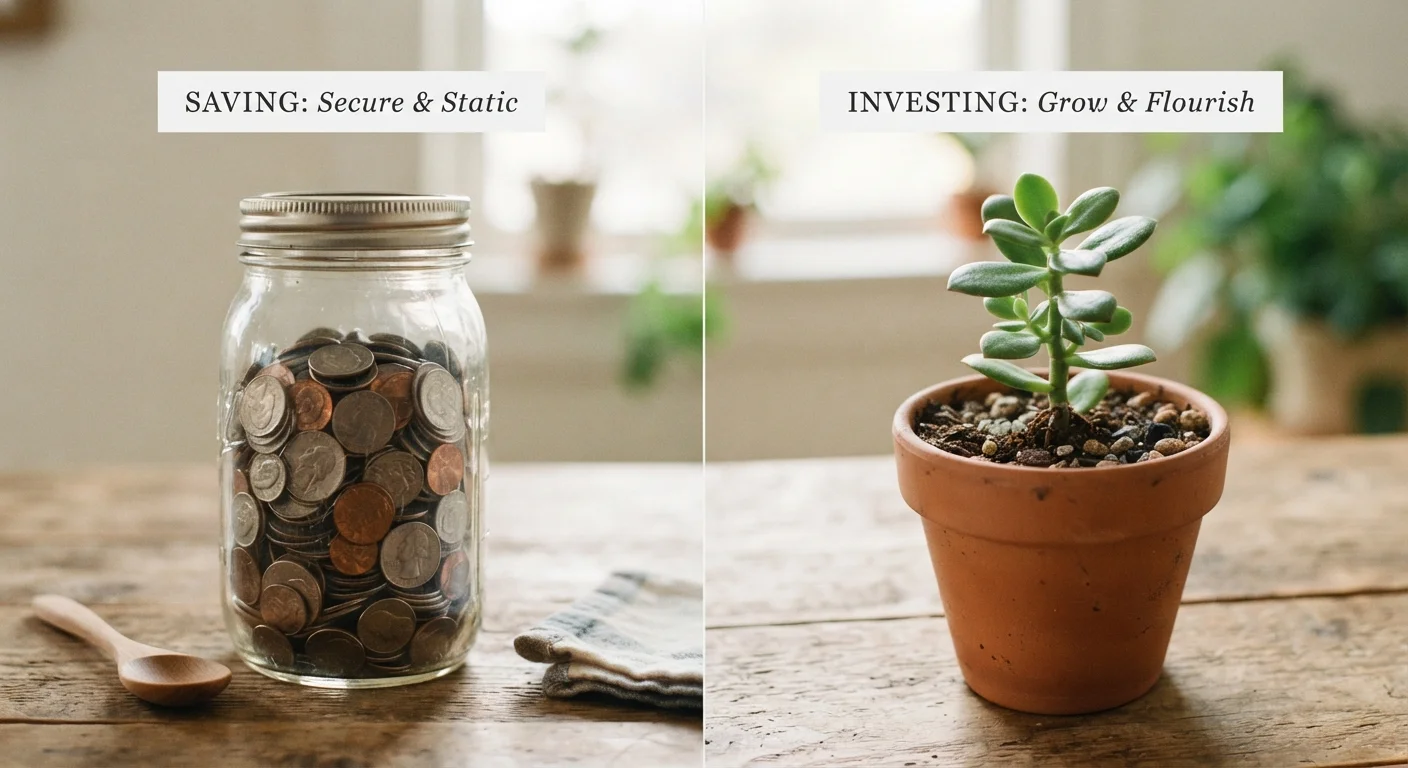
- Investing for growth: HYSAs are savings vehicles, not investment vehicles. If your goal is wealth accumulation over time, understanding the difference between saving and investing is an important next step.
Limitations and Risks to Understand
High-yield savings accounts are low-risk - but not without trade-offs. Being aware of these limitations helps you use them effectively.
Variable rates: The APY is not locked in. If the Federal Reserve lowers interest rates, your HYSA yield will likely fall too - sometimes quickly. What looks like an excellent rate today may be modest in six months.
Inflation risk: Even a strong HYSA rate may not keep pace with inflation during high-inflation periods. This means the real purchasing power of your savings could erode over time, even as the nominal balance grows. HYSAs mitigate this better than standard accounts but are not a complete hedge.
Transfer delays: Funds held in an online HYSA may take one to three business days to transfer to an external checking account. This is usually not a problem for planned expenses but can matter in a genuine emergency requiring immediate access to cash.
Tax implications: All interest earned is taxable as ordinary income. If you're in a higher tax bracket, factor this into your net return estimate when comparing options.
Being intentional about these limitations also means staying alert to common savings pitfalls that can erode your progress over time.
Automate Deposits to Build Your Balance Faster
Setting up automatic transfers from your checking account to your HYSA on payday removes the temptation to spend first and save later. Even modest recurring deposits compound meaningfully over time. For a practical framework, see our guide on building a savings habit from scratch.
This article is for general informational and educational purposes only and does not constitute personalized financial advice. Consult a qualified financial professional for guidance specific to your situation.