
How Each Approach Works
Before comparing the two, it helps to understand the fundamental mechanic behind each. If you are new to investing, our article on key investing terms is a useful reference for vocabulary like expense ratios and diversification.
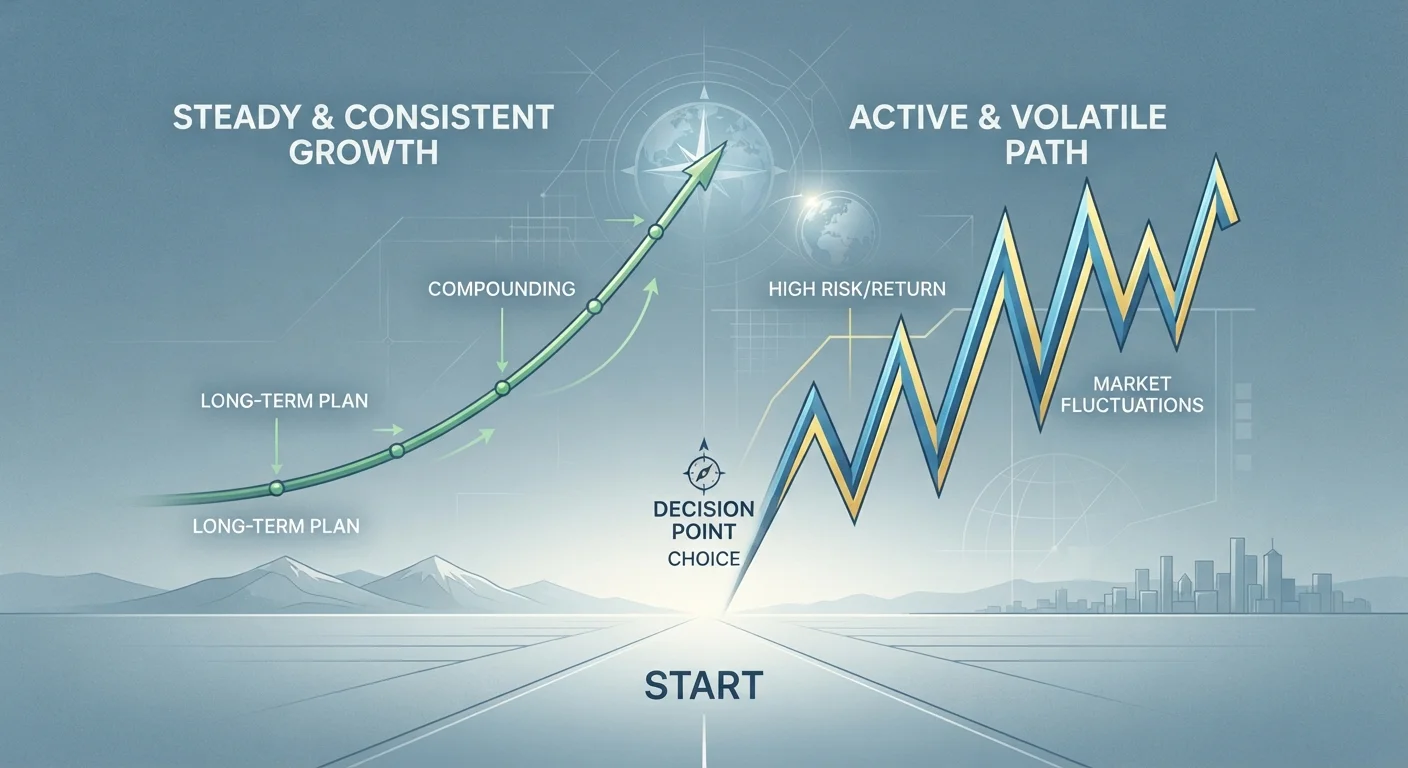
Index funds are designed to replicate the performance of a specific market index - such as the S&P 500, which tracks 500 large US companies - by holding the same securities in the same proportions as that index. Because no analyst team is selecting or timing trades, the process is largely automated. The fund's goal is to match the market, not beat it.
Actively managed funds employ portfolio managers and research teams who make deliberate decisions about which securities to buy, hold, or sell. Their stated goal is to outperform a chosen benchmark through superior stock selection, market timing, or sector rotation. That expertise comes at a cost paid by investors through higher fees.
Understanding how these funds fit into your broader portfolio requires clarity on asset classes. Our guide on stocks, bonds, and cash explains the building blocks both fund types use.
| Criterion | Index Funds | Actively Managed Funds |
|---|---|---|
| Management style | Passive - tracks an index | Active - manager makes security selections |
| Typical expense ratio | 0.03%-0.20% | 0.50%-1.50%+ |
| Goal | Match market benchmark returns | Outperform market benchmark |
| Long-term benchmark-beating rate | By definition, matches benchmark (minus fees) | Majority underperform over 15-20 years |
| Portfolio turnover | Low | Generally higher |
| Tax efficiency (taxable accounts) | Generally higher | Generally lower |
| Transparency of holdings | High - mirrors published index | Varies - disclosed periodically |
| Complexity for investor | Low | Moderate to high |
Cost, Performance, and Tax Considerations
Cost is where the contrast between these two approaches is starkest. Index funds typically carry expense ratios - the annual fee expressed as a percentage of your investment - well below 0.20%, and many broad market index funds sit at 0.03% to 0.10%. Actively managed funds commonly charge 0.50% to over 1.00% annually, and some carry additional sales charges known as loads.
Over decades, this fee gap compounds meaningfully. A 0.80% annual fee difference on a $50,000 investment growing at 7% annually amounts to tens of thousands of dollars in reduced returns over 30 years - a purely mathematical consequence of compounding, not a prediction of any specific outcome.
~85%
Active large-cap funds underperforming S&P 500 over 15 years
According to S&P Dow Jones Indices SPIVA US Scorecard data, the large majority of actively managed US large-cap funds have trailed the S&P 500 over 15-year periods.
0.03%-1.50%+
Typical expense ratio range across fund types
Morningstar's annual fund fee research consistently documents a wide gap between average passive fund fees and average active fund fees in the US market.
$240B+
Annual net flows into US index funds
Investment Company Institute data reflects sustained, multi-year investor preference for passive vehicles over actively managed mutual funds in the US.
On performance, a large body of independent research - including SPIVA scorecards published by S&P Dow Jones Indices - consistently shows that the majority of actively managed funds underperform their benchmark index over periods of 10 to 20 years, after accounting for fees. That said, some active managers do outperform over sustained periods, particularly in markets considered less informationally efficient. Past outperformance does not guarantee future results.
Tax efficiency is another practical consideration. Index funds trade infrequently, generating fewer taxable capital gains distributions. Actively managed funds, with their higher turnover, may distribute capital gains annually - a potentially meaningful tax burden in taxable (non-retirement) accounts.
Choosing between these approaches also connects to how you structure your overall budget for investing. Our article on the difference between saving and investing can help clarify how much you should allocate to long-term investment accounts in the first place.
This article is for general informational and educational purposes only and does not constitute personalized investment, tax, or financial advice. Consult a qualified, licensed financial adviser or tax professional before making decisions about your own circumstances.